snow

The Boy's Winter


I was wakened by the subtle flash and rumble that, not more than a minute later, became the brilliant glare and shattering crash of this year's first post midnight, pre dawn thunderstorm. The rains came, soaking what would normally be earth frozen forty inches, give or take. The birds had been arriving for over a week, vees of geese are seen and heard, while the prehistoric calls of sand hill cranes are heard, all traveling northerly. Comb-playing chorus frogs have made their seasonal debut and chipmunks have ascended from their dens. The grays and pale orange-reds predominating the woods are often punctuated by intense, moisture-activated greens. Most lakes have lost their ice and those that haven't remain only a stormy-green skim coat of icy slush. Most of all, even by last year's early spring standard, the trees have been budding strong and flowering early. The silver maples of the middle slough have been fully in flower for over a week. This is El Nino in the Midwestern north.

It should still be winter by calendar, averages, and tradition and this post should be timely. It is not, however, by fact and experience. Winter is over before its time and this is its eulogy.


Strong winds raked snow and desiccated grasses across the large wetland, leaving easy access for bipeds like myself.


This winter's fluctuating temperatures created a nearly constant stream of runoff from the little wetland which pooled at the northern end of the large wetland. It was a popular watering hole for all the Big Woods' animals.


Freezing and thawing of the pool made for unique ice crystals.


The dead trees of the large wetland, killed by higher water or blight.


Orange lichens on the south side of the trunks.


Wet feet is not a problem for Red Osier Dogwood, Cornus sericea.


Its branches a brilliant red in the sunny open of the wetland.


A protective structure for warm season nesting.


An unknown plant, possible weed, growing in the center of the wetland.


A rare view of the house from the wetland.


The earliest sign of approaching spring -emerging buds of shrub willows.


Snow on the Sugar Tree


I woke to collect any sap to come after the prior tipping.


That's when the snow began to fall.


Two hundred fifty six ounces of sap, nearly fluid as water, and hardly sweet.


And the snow continued to fall.


The sap continued to boil, scenting the kitchen with caramelized sugar.


And as the snow began to accumulate


the sap grew thicker and thicker.


Nearing one fortieth the volume, it left the pot for the filter.


When it was over, four inches of snow


and eight sweet ounces of maple syrup. 


Feeling Out Boundary


For years I have been looking across the wetland, visually leaping from this side to that. I hardly noticed it was a farming plot, hardly recall seeing corn or soy. When visitors see it from the upper floor in the snowy winter, they say how nice it is that we have a view of a lake, which is of course, an illusion. For quite some time I wanted to follow the edge of the wetland, crossing the wide drainage that marks southwestern boundary of our land, and I knew well enough this had to happen in winter. It turns out March is a good time, the soil is deeply frozen, and the air might be fifty degrees.


At the beginning of this great March melt, snow becomes puddles, ground frost begins to let go.


Water is beginning to move. A warmish day, sunshine, and then an attraction to any hint of burbling, the sound of moving water, is the first symptom of spring fever.


Crossing the wide drainage at the southwest corner of our lot where electrical infrastructure meets the woods, marsh grass and cattails meet the scoured land of the gravel mine. This is a boundary I've often met, but never crossed.


Along the western edge of the wetland we find the most Eastern Cottonwood, Populus deltoides. It likes wet feet, and can be found on wetlands, along streams and rivers, on lake edges, and occasionally upland. Large trees with trunks often bending and soft wood, they are prone to break. This is the source of its common name, I think, not the downy white fluff it distributes in late spring.


The wooded hillside slopes sharply, then levels out in a zone that accommodates occasional flooding. I have found that the four-legged and the two-legged creatures like to share paths whether made by us or by them. Here, we walk along a well-trodden deer path, one well-scoped by bow hunters.


As we gain on the farm field, the land rises up just enough to take it out of the soggy soil well-defined by the Cattails, Typha latifolia. Here I see a close resemblance to an oak savanna, a wonderful little spot containing grasses, annual and perennial plants, a large Bur Oak, Quercus macrocarpa (I think) and several smaller ones.


Growing too are large buckthorns with their countless berries. The oaks probably pre-date the buckthorn. New oaks are unlikely to be seeded, sprouted, and survive the shading without the regular fires that give oaks an edge.


Lichens (maybe orange Xanthomendoza weberi and grey-green Physcia aipolia) grow on even the lower oak branches. Rampant buckthorn growth will shade out the lichen too. I have to start seeing the positives of buckthorn, what were they again?


The farm road, which bisects the wetland and forces the drainage through a culvert.


The immaculate, stone free, black earth of the farmed hill to our south. I wonder why cover-cropping is not practiced in this region and have yet to do the research. I suspect that there might not be enough growing season to get soy or corn and sprout a cover before a freeze sets in, but then I am guessing. According to the MCWD, an agency that monitors our watershed, our sub watershed is draining phosphate-laden water to Dutch Lake. This field is near the head of the shed and yet another guess is that it's providing a good part of that input. Residential septic systems and lawn fertilizers are providing the rest. 

My knee-jerk response is to worry that it soon will have homes on it. The owner leases it to a local farmer, and from what I can find, its owner does not live on the property which totals 68 acres of woods, wetlands, and farm fields (other than this farm field, which is isolated by topography, woods, and wetlands). A quick search shows the owner as Stone Arch Development, but a google search for that shows only a corporation named Stone Arch Organizational Development. Adding more complexity to property ownership, the notion that our own "development" is acceptable, but any future development should be off limits, or at least out of sight. 


At the culvert, water flows in from the big marsh.


And flows out toward the south, draining another few miles of wooded hillsides, residential yards, and horse fields until it reaches Dutch Lake, and ultimately into Minnetonka, overtops into Minnehaha Creek, sent over the falls, then into the Mississippi, and off to a stint in the Gulf of Mexico. 


Turning back to the north we get the only wide open view of the woods within which we live, apart from satellite views. The cropped view highlights the house, toward which I drew an arrow. Witnessing the open, bright marsh and dark woods together was an eye opening experience.


22 To 50


A 22 degree halo on what was a very nice day, springtime really. This past Thursday we climbed out from a low of -11 degrees F. By next Thursday we will have had a string of sunny days 40, 50, and maybe even 60 degrees F. But hey, let's not get indulgent, I'll take the sunny, 40 degree day.

While I doubt the white ground cover will permanently take its leave (we did just get 5 inches last Tuesday), a good guess is that it will be gone by Monday evening. What I like best is the brilliance of snow covered ground, 45 degrees, little wind, and sun. In fact, that's what I'd like for my birthday.

Tread Of Time


The night is dark but for the power company's safety lamp. It is dangerously cold near, below, or well below zero. The wind blows, not a howling, but a deep woooh through the trees. The whimpering of the iron porch rocker transcends walls, its complaint in every room. If you stare into the night, nose chilled by the cold relay of a double-paned window, you will see little, if anything, but the sodium lamp's sickly orange-yellow glow cast onto the woods and snow. Turn out the lights and sleep. Only daylight brings the ghostly imprint of Disney's dark dispatch, the tread of time debossed into crystalline water, our drive the Grauman's of faunal drama.


Our porch steps a barrier -for now.


           _________________________

On March 1, 2015 I will discontinue posting on NYCGarden. You can continue to read my posts here.


My Beating Heart


Some days I wake before we've rolled around to meet the sun.


By the time I get dressed for the cold, stumbling through, half asleep, the sun has breached the canopy.


A light snow fallen the night before drew me out from the warmth. The farm field, behind the scrim of trees, changes weekly from white to mottled gray to black and then white, again.


It is still.


No rustling of cold-crisp leaves, no creaking of timber, no muffled doof of dropped snow glops. There was a squirrel motionless, vertical, on a dead or dying red oak. Fixed on that spot for quite awhile, I say this squirrel did not make a move. To my right, then, an explosion of noise! My head jerks upward to see a squirrel bursting out of a leafy nest wadded into the crotch of another red oak, then scrambling into the branches of a different tree. I thought how rare that I should get out of bed before squirrels.


I was about ready to come in from the cold when Betsy came out dressed for a walk. Not too far she promised, just around the bend in the road. Outside for half an hour, not moving but for camera work, I was pretty cold, but I joined her. 


- I am the still squirrel and Betsy the exuberant one. -


 At the end of the drive, up slope, frosted pines, spruce, and aspen grow in the clearing.


Down slope, sumac curlicues tickle the sky.


I see a prop plane traveling northwest and I think how cold it must be in that cabin, single engine planes fly in pleasant weather, and then I understand -it's about the stillness.


Around the bend, a roll of hay, unused, under a willow.


And the matted grasses.

___________________________


On March 1, 2015 I will discontinue posting on NYCGarden. You can continue to read my posts here.


April Snow Showers


This is the last of the snow in our yard, somewhere around eleven thirty ayem. The Elephant garlic could care less.


Each of Larry's pots, all on the shady side of the block, had a collection of slow-watering snow to melt.


But the tulips were all whatever.


Snow Spring


I remember an April as a child. It was cloudy and as I recall not all that cold. My mother was home and I was toolin around on my bicycle with my brother on the handlebar. Then, out of nowhere, it began to snow, giant clusters of frozen precipitation. My brother, younger than I, was frightened by this and wanted to go in but I resisted -until the giant clap of thunder! That was a snow in April. 

So this is still March, and night, and I'm not six. Yet still, a snowfall after the start of spring is worth noticing. 


Deliberations On A Snow Day


 The snow is falling pretty heavily right now, say between three and six inches an hour.


The radar verifies, but also tells us the transition from snow to rain will be quick when and if it does. The snow is a little clicky on my windowsill, so it may already be doing so, but the wind is also picking up and quite gusty.


With school canceled, once again, I am faced with a day unto myself. Hmm. Brave the storm to get to the overheated studio or work on things at home and stay close to the electric heater? Tough questions. I think I may head out to the coffee shop, then venture the wind, the cold, and the bus ride to the waterfront studio in Sunset Park. That's a plan anyway.


Great White Way


I can't say I've ever seen the trees like this, after a snow, in front of my place of employment near Columbus Circle. A wet snow, clingy, and brilliant sunny day led to some dazzling scenes. Usually the wet snow comes with a temperature change and it melts quickly in the sun, glopping onto the street, or as happens more often, there is a wind after the cold front passes which whips the snow off the branches. Not this time.


I had imagined going into Prospect Park before work, to get shots for paintings with Betsy's new camera, but convinced myself that the sun and snow would be too bright for that purpose. When I came out of the station at 59th I was stunned by the grip of the snow on the branches and wished I had time for Central Park.


Crossing Broadway.


Delicacy


I've nowhere well-lit, particularly on these darker, cloudy mornings to place a vase of flowers for a photograph. The kitchen stove always fares best as a table, and even then on top of a cast iron dutch oven. The light streams in from the window beside, a faint rectangle on the vase.


The leaves of the crimson Salvia elegans blacken at the freezer's edge, so I cut it. But the chrysanthemums, or what are they called these days (when I purchased one it was Chrysanthemum "Sheffield Pink"), are hardly not hardy. They will droop with the sop (that which makes it sopping, no? I will use it anyway), but afterward perk up. I've seen them through several snows. 


The irises, however, are delicate in cold and rain. I went out late last night to cut for the vase and now they glow and perfume our indelicate place.


Welcome Sun


Fallen limbs.


The hair cut hydrangea and our block's most red tree.


In the midst of the storm I went out to grab the iris. I guess we have two months extra winter this year. At least yesterdays freak weather has me feeling that way.


Snow Blow


Betsy has Marie's camera, worried that I was going to forget it for our trip to garlic land. So, I had to use our lousy camera for some shots of what to me is pretty miserable. The effect of the lousy camera is spot on - looks like miserable. I usually have flowers well into December, although some years only making it to Thanksgiving. To see so many irises succumb to snow is sad -how often does an iris see snow?

New Dawn has seen snow, or at least it's hips have. This weather not only ruined my plans to finish up garlic planting, but has also ruined so many asters, chrysanthemums, gaura, even cosmos and phlox still blooming. I'm all for the first snow, but this is a low blow.


Well Whadya Know


Let me be the first to say that snow flakes of the wet and fat kind have fallen. Never in my NYC area life have I seen snow before Halloween. Frost, yes, but never snow. I can recall some light snow flakes in the first weeks of November. I have to cancel my garlic planting trip not so much because of the snow, but because of the driving conditions expected tonight in the Hudson Valley. It will have to wait two weeks. 

My exhibition is next weekend and I may as well hit the studio and get the hell out of this unheated apartment! I know it's cold when the cats go under the cover on the couch instead of splay out on top. Two bumps on the ol' log.


Lord of the Land


I've received a couple of text messages concerned about the weather this coming weekend. Snow they say, freezing temperatures too. No matter say I, the garlic is fine and the weather on Sunday should be okay for planting. Yet, this morning, while preparing for work, I hear my landlord instructing one of his workers to cut back all the flowers. Wa?!? I race outside to see what is going on.

Yes, the asters and mums and sunflowers and gaura and cosmos have all leaned forward from the heavy rain, but also to beg for as much sun as possible. They extend out past the old iron fence at most 10 inches in spots. There is ample walkway for one, and what sour soul could demand that flowers be cut away so not one brushes the legs? 

Offended party now on the scene I want to know why he needs the flowers cut back to the fence line. Because of the snow, he says. So I can get the snow blower through, he says. THE SNOW BLOWER!?! It's only October I explain. I always cut back the plants after the first real freeze, which year in and out has tended to be anywhere from November to December. 

Fine, I say. But don't have your guy do it, I'll do it, like I always do long before it snows. I wrap the corner and see that his guy already did the side yard, hacking back the climbing hydrangea to the fence, trimming its graceful trusses to a jar head. Same for the cosmos, the chrysanthemums, and when he tells his guy to pull out my sunflowers I protested. Of course I want those, I planted them!

Snow. Yeah, right. 


From My Perspective...


..in 85 degree Florida, it will not snow in any significant quantity midweek. One reason is that I do not want my flight effed with, and the other reason is that the freezing temperatures the snowfall depends on are marginally so at best, with the colder air mass coming in after the precipitation, while dropping below freezing only at night. The likelihood of snow is quite low, and from my warm perspective, just amped up weather suggestion.

That said, the beach farm seedlings may be challenged a couple of evenings later this week. The daffodils? They'll be fine, in fact, better for the cold. Heat does those flowers in way faster than moderate cold.


Opening Day


It was opening day yesterday, as all the neighborhood stopped to chat while I was out cleaning the garden. I even got to crane my neck chatting it up, old style, with my neighbor upstairs (ack, apparently the window affair will be starting up again).  It was time to open up the garden to air and light, removing leaves and litter, and open up some new possibilities.

I raked leaves that never had a winter's chance to blow into corner catches, matted under the all-winter snow, creating a comfy, never did freeze environment for over-wintering perennials. I hesitated for just a second, thinking there's well enough time for a long, hard freeze for these newly exposed leaves. But then I wanted to rake, to clean, and did a cursory job, leaving some for later. I also pruned out all the lower branches of the climbing hydrangea, in hopes that they will not catch trash and to minimize the privacy so many neighborhood cats find under there.

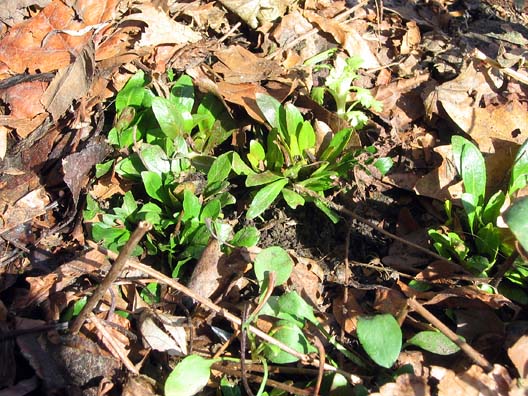
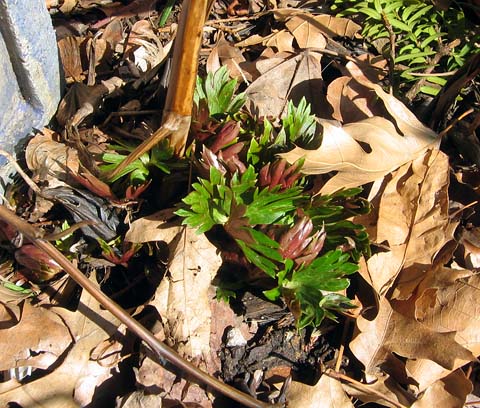
I could have photographed all the bulbs coming up, but after three years blogging, who needs more of that? I was impressed with the greenery of the Aconitum, or Monkshood, that was just a few days ago covered in a pile of snow.

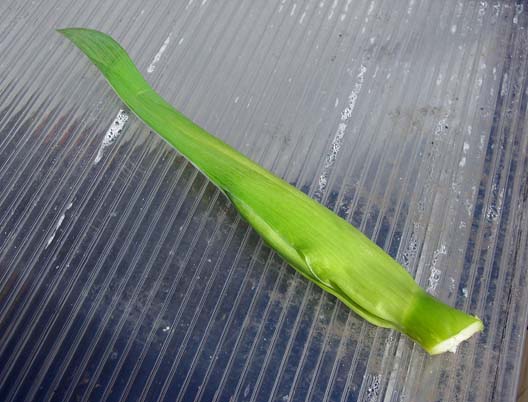
You may or may not remember that I had some late, late irises in December. While cleaning the iris bed out, I found some stalks that had budded, but ceased to grow, remaining under snow for most of winter. This one I had cut and peeled open, revealing no sign of rot. In fact, the bud seemed perfectly healthy and ready to shoot up this spring. Unbelievable. I left another intact, just to see what happens.

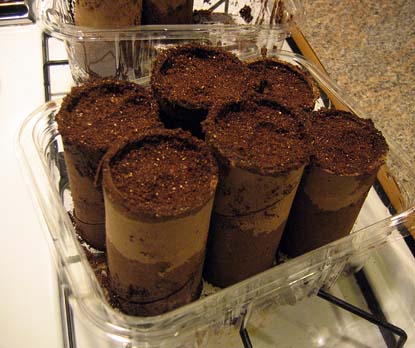
I've started some snap peas in bond paper tubes and every quick glance makes me think I'm seeing chocolate cake.


Presidential Snow


I presided over the holiday by going to the park to photograph. On the way...


Snow that clings, reanimating, the rose kinetic, a hydra, but then Hiroshige's ukiyo-e.


 Financial crisis construction.


You can imagine the earthy pitch scent emanating from these trimmed yew.


Crabapple circle.