locally grown

Cooking Local


Allium tricoccum var. burdickii, prepped for cooking, common to our woods (99.5% are this variety) and delicious. They are milder and I think sweeter than the more common, larger-leafed, red stemmed ramp. I've made ramp pizza, pasta with ramps, stew with ramps, eaten them raw, put them in nearly everything. One of my favorite spring dinners is asparagus and eggs. Why not add ramps to the mix?


First, I made some polenta in our rice cooker.


Six organic eggs from our local farm park.


Fried some naturally cured bacon from the very same local farm park.


First layer asparagus and ramps, then eggs, and more ramps on top, cover, cook and flip once.


Stack polenta, bacon, egg, asparagus and ramp mixture. Add grated Parmigiano reggiano and black pepper to taste and I like to drizzle Arbequina olive oil over the top.


Meat Run


On Saturday, hours before the torrents that afflicted us later in the day, we went upstate to pick up a new order of pork, beef, and eggs at the Lowland Farm. I would have picked up some chicken too had I thought there would be room in our freezer. Rib steaks, London Broil, ground beef, hot dogs, and beef shins for us as well as more pork hocks, ground pork, boneless shoulder, tenderloin, bacon, and cured cheek. I love the cheek, I put it in anything. At first we thought the bacon was too salty, but that was only because we weren't eating bacon at all. Now we eat bacon once a week. The hocks make a wonderful, if unconventional osso buco. And to try, I added a cured ham steak (eegads!) and cured hock. We've already eaten the London Broil and rib steaks, both with flavors unknown to me until now -sweet and mellow.


My decision to eat only humanely-raised meat has been good for me and my diet. The expense had led me to believe I would eat less, but so far I have not seen that happen. Buying a lot of meat at once not only saves us money, it alleviates some of the sticker shock of individual cuts of local meat at the farmers' market. My eating habits have changed since late January and there have been improvements in the way I feel and some weight loss. We've been eating many more salads for lunch, so I'm glad that our lettuce is coming into its own now at the beach farm. Most improvements I have felt stem from cutting out the crap I would eat for lunch or dinner because I didn't plan properly for eating lunch or dinner! At school this means no more chicken and rice from the cart right outside the front door. For dinner this means no more take out chinese/pizza/something else. I've also reduced my pasta intake -understand how difficult this is for an Italian American! When my ridiculous supply of dried pasta is gone (and it soon will be), I will only purchase high quality local pasta to eat occasionally. Of course, I've cut out soda (except tonic) and hardly touch beer. I avoid juice too, but we have yogurt and frozen fruit smoothies on many summer mornings. My goal is to lose twenty pounds by August, a goal somewhat set by my surgeon who refused to fix a hernia I happen to find myself with until I lose at least twenty pounds. I have not been weighed, but based on the pant waist scale, I've already lost about ten. The ultimate goal, a goal which will require much more than I have already done in terms of exercise and eating, is to lose forty pounds.


February Farm Market


I go to the farmers' market in the depths of winter for the apples. I haven't purchased a grocery apple in a dozen years. Fuji is my go-to, winter apple .


Carrots, mounds of carrots -purple, yellow, and the obvious orange. I buy them all. If they were organic, I would appreciate them even more. The two organic farmers who sell at Grand Army in winter do not sell winter carrots.


Here's another reason. Flowers. Outside. In winter.


There are many more meat farmers at Grand Army this winter, but I do not partake. The price is usually out of my league. Ground pork at this stand was on sale, $6.50 -down from $9.50. I partook. Since my decision to buy only humanely raised and slaughtered meats (which usually means capital O, organic), I've been buying meat at the co-op on Cortelyou. We are definitely spending more, but we are still eating meat because I buy only the lower cost cuts, and the co-op keeps prices down by not sourcing hyper local and not using the smallest producers. Buying this way has limited my options just a bit too much.

A little over a month ago I decided I wanted to buy from a local, small producer of pasture raised meat. A whole steer would have been biting off more than I could chew, so I sought out a farmer raising hogs as well. When you buy a whole hog, the price is multiplied by the post-slaughter weight, what is called the "hanging" weight, which means you will pay for weight you do not eat. This is usually about 40 pounds, or put another way -about $180. Add to this my cost of gas and tolls for pickup and delivery, and the cost goes up another $60.  The remaining 140 pounds of hog will be butchered, divided into cuts, frozen fresh or smoked, labeled, and sent back to the farm.

I found six households to go in on the whole hog because who can afford $1000 for hog? More importantly, who can fit a hog in their urban freezer? Each household will receive about 28 pounds of cuts, and each will receive ham roast (smoked or fresh), shoulder roast, several ribs, several loin chops (1 inch thick), belly bacon (smoked or fresh), and ground pork. Based on the prices in the picture above, these alone should drive the cost well over each household's $170 investment. The remaining cuts, which include the tenderloins, extra bacon, ribs, and loin chops, hocks, smoked jowl, cheeks, ears, tails, organs, and leaf lard, will be haggled over by the group. We'll all meet at a central, Brooklyn location so the extras are divided as fairly as possible. I think we will see a price of about $7 per pound for all cuts, which is less than I pay for a pound of ground pork at the co-op.

Of course, the decision to do this goes beyond cost, but to do better, to treat animals and the land as best as we can. I do expect better flavor, but that is not my primary motivation. If all goes well, this will be our model, and possibly expand to include another six households to bring down the pickup and delivery costs even more. Maybe we'll venture into steer territory too, but let's not put the cart before the ox.

Update: I corrected the math above, bringing down the price a bit.


New Amsterdam Market


In a little less than three weeks I will have my first garlic sale event at New Amsterdam Market. I've never been, so I've been image searching the market to get a sense for the space, tables, and overall aesthetics of the market. I think the pictures give a good sense of the atmosphere. Don't laugh, either, it is that kind of creation. Robert LaValva, the architect of the market, has insisted on designing a sense of place so that all the tables, signage, and what-have-you are identical no matter what the vendor is selling. It's as if the civic space/marketplace has become the product, not only the venue, and the local producer/vendors participate in his work. I get that and I think Hudson Clove's aesthetic sensibility fits well into his scheme as far as I can see from my Google image search.

Now I will make some low-rise pine wood crates to cradle the different varieties of garlic and shallots and maybe a two tier pine tower to display garlic bundles. Should saffron come into play, at a later market, I will need to devise a system for packaging and selling the threads. Maybe you can tell me how much saffron is enough saffron in a package? Marie, ideas?

Finally, you should know that New Amsterdam Market and it's environs are under threat of corporate development. Please read this article in Serious Eats, as it tells you all about it and why New Amsterdam Market is worth saving. The horror of the American suburb is its utter homogeneity, its total fear. Every new mall and false village filled with the same franchises dulls our collective senses. Fearful people who dream of opening new businesses but have little new ideas or the stomachs for risk -they open a franchise. Risk-taking residents try the new Potbelly sandwich instead of Subway. High end or low end, it's all the same, and I hope ingenuity can withstand the forces of homogeneity this time around.


Fodder or Folly

I landed on this video presentation regarding a fairly well-worn topic these days: local food production. I watched it primarily because I am putting together a proposal for a, how should I say it, "micro-park" that takes the form of a food garden. Inherent to this project (folly?) is my life long interest in gardening, an interest in park design, our current obsession with food origins, and nagging thoughts that we have an increasingly abstract and aestheticized view of the farm and food garden. A quiver of doubt slung over my shoulder, I go back to my proposal. Below, the presentation:


Long Live the Christmas Tree

When I worked for a NYC garden designer, it was a matter of business to be putting up Christmas trees and holiday decorations after the last frozen impatien was pulled out of the soil. I hadn't understood that holiday decorations were a gardener's business until then, or that it was in Manhattan, on certain streets. I thought, until those under-lit December days, that a family would be spirited into selecting their own tree, hanging their personal decorations with the kids, and generally enjoying the spirit of the moment. But for some, selecting and mounting a live-cut tree is a gardener's business and happy is the gardener to take in some extra cash before the long dry spell of winter.

J&L Landscaping, my local nursery, has brought in the post-Thanksgiving selection of cut Christmas trees. I like to smell them as I pass to and from the subway. It tells me what time of year it is, should I forget for not hearing 24 hour Christmas tunes on the radio. There were quite a few years where I felt I was a live, uncut Christmas tree kind of guy. Despite my feeling for this, it was largely a theoretical notion as I have never actually done this. Nor is it practical in the city or anywhere, really, as the tree will suffer going from a cold exterior environment to the warm, dry of the house and then back out again into the freezing landscape. I think I could keep it alive, but not without complete devotion.

Recently I heard an npr radio announcement for an ad man who wants to modernize the image of Christmas, noting with particular difficulty the modernizing of the "overly 19th century Santa Claus." I think the plastic tree, for a while anyway, lent the flavor of modern to home adornment during Christmas. Yet, I think the reason Christmas lands so squarely in the nineteenth century (or earlier) is, of course, the sentimental nature of the holiday. But isn't it also because the 19th century is a time far enough away for it to have the tone of simpler times -but close enough for us to be able to relate? Somehow, too, images and thoughts amount to 19th century life as closer to nature despite industrial realities and major resource depletion of, say -trees. Our live Christmas tree brings us closer to an image of us in spirit with the natural world, connected. Even if collecting our Christmas tree is a bit of ritual theater, the symbolism is overwhelming and might even be superstitious if it weren't so abstract, so truly distant from our lives.

My wife and I go to Minnesota to her father's place every Christmas. He goes out to a tree farm and cuts a grand tree every year. Its always set up by the time we arrive. We do not always get our own tree because we are never in our house for the holiday. But some years, we do head around the corner to J&L and pick out a short balsam or noble fir for our apartment.

My family has teetered between plastic and live-cut trees and have now comfortably settled into the "don't have to go shopping for a tree and don't have to vacuum needles" option that is the plastic tree. I don't complain.

I recently came across the National Christmas Tree Association Tree Types web page. Who knew there was an association for the Christmas Tree? And why not? I guess it would be more responsible, but less spirited, to have called the group the National Christmas Tree Growers Association. Anyhow, on their page they list the 10 Myths of the live cut Christmas tree- according to them.

Most of what they state seems reasonable enough, but in our urban world distaste for pesticides, fungicides, and the like is pretty strong. So the only myth they might not have succeeded in debunking is that one, in my opinion. Problem is that no-one wants bugs or unhealthy trees in their home, but don't want the residues of treatment either.

What of the environmental debate: which is better, the fake or the live?

The Council on the Environment of NYC has a local grower's list for pickup at NYC farmer's markets.
The Brooklyn Botanical Garden Christmas tree identifier.

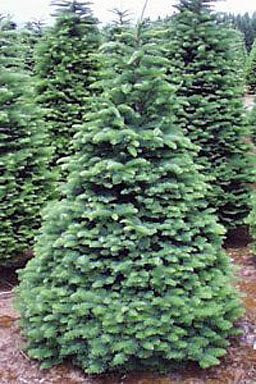
Some different types of Christmas trees available locally:

Some images courtesy of the NCTA


Noble Fir


Fraser Fir


Balsam Fir


Colorado Blue Spruce