Beach Farm Bye Bye


By the time you read this we'll have completed our 1250 mile drive, in our twenty two year old van with cat in tow, to Hennepin County, Minnesota. I'll blog from there when I get the chance -there's been a lot of rain there, so I'm expecting August mushrooms. Also, I got a replacement Olympus XZ-2, just days before the price went back to $599 (double what I paid, but then I had to buy it twice!). Today was the first day the camera got out of the house and I am very happy to be able to occasionally disappear into photography during our time in Minnesota. 

It's hard to believe our two plots were all garlic only three to four weeks back. I haven't seen the beach farm since then, when all the garlic was pulled and buckwheat seed planted in the newly empty space. 

Our new plot is kinder to warm weather vegetables than it was cool weather garlic.


I've let the bulbing fennel bolt. Just haven't been around for a proper harvest.


I'm amazed at the size of the Swiss chard stems -like baseball bats, believe me they are bigger than they look here. The leaves are gigantic and we can't harvest them fast enough. The weather has been chard perfect. These were started from fairly old seed, too. Good to know not to throw those out too soon.


Let the cilantro bolt -that is the plan. Took me years to figure out how to cultivate cilantro and the answer is to plant seed, hope for the best, and should it sprout and grow then allow it to self seed and it will hardly ever require replanting.


Some lettuce has bolted and I'm wondering if it will seed itself and true.


I wanted the other plot to rest after years of cultivation, so I planted what amounts to probably too much buckwheat. It's growing like mad now, necessitating a weeding along the edges of the row of vegetables I planted three weeks ago.


On one end, basil.


On the other, Japanese eggplant.


And the middle? Sweet peppers.


Without much tending other than a few applications of organic fertilizer 5-5-5, they seem to be doing okay. Some have begun flowering and fruiting.


 The sea of buckwheat should grow another foot or two.


And threatens to swamp a random tomato plant and the row of vegetables. Buckwheat is a vigorous grower, used not only as a green manure when turned it, but also to keep weeds in check by shading them out. Of course, some eat the seeds and some the flowers. Not me, however, not me.


We have some green tomatoes, although all my neighbors have red. After all, we planted in July, after the garlic was lifted, and hope tomatoes will be ready when we return from Minnesota.


Nothing special this year (general 'plum,' 'beefsteak' and 'cherry') as I bought only from Larry's, although there may be an heirloom or two in the plots that have volunteered from the prior year.


The Cure


All the garlic is hung in the studio, makeshift, along the radiator, beneath the window. The leaves are dry and thistle to the touch. The mold on the dried leaves, invisible to my eyes but not my nose, has me sneezing with too much rustling. I wear a mask for bulb cleaning. All appear to be curing well, some already finished, some a week or so to go. Labeled bundles will be available in limited quantities come mid-late August. Hop on over to Hudson Clove to order in three weeks. 


Asiatic 'Asian Tempest' did better than all other years combined. Garlic growing is a fickle affair -one year bad, another year so so, another great. Always something new, always a challenge, always a surprise!


Artichoke 'Lorz' outperformed 'Red Toch,' although grown side by side I think this was just dumb luck. Both strains lost nearly 2/3 of what was planted -the 'Lorz' is larger thanks to a later harvest.


Silverskin 'Silverwhite' did quite well in the poor, new plot that lost so much garlic. They don't look it here, but they are easily double the size of any Silverskin I've grown in prior years.


Famed, difficult Rocambole 'Spanish Roja.' I grew about twelve from last year's surviving bulbs. They did well and I will likely plant these very cloves. I can wait for it, patience. I have a good quantity of 'Russian Red' and 'Killarney Red' Rocambole available for the bundles.


The Art Of A Week


Ten days back I arrived at Bennington College's bucolic campus to teach my master course Landscape and Meaning for Art New England. Over the course of five days I watched the fields shift from tall meadow to cut hay, then rolled into yodels for ungulate fodder. You could say nature was converted to culture before my eyes. Above, a sixty thousand dollar view (education included).


Sunday arrival and orientation.


There was a twelve-hour ice cream bin, but I did not partake. I did think it looked awfully like a tray of watercolors. The food was designed by a corporate service for college kids and as it happened -I ate like one. Probably my only weekly weight gain since I chose to eat quite a bit differently last winter.


On the final evening the students bring the week's work to exhibit in the main arts building. We had only four students but they had more than enough work to fill the enormous wall. And they worked beyond the limits of painting -there were nearly 200 pages of reading, hour long discussions morning or afternoon, and one student even wrote a two page essay.


The final critique, Saturday morning. Only brave people sign up for a course titled Landscape and Meaning where the description contained words like conventions and interrogation. My students were open, inquisitive, focused and productive. A teacher could hardly ask for more.


I cannot teach meaning, but I can provide context and cultural attitudes, we can view our works through the perceptive lenses of Marxism, Feminism, and social or cultural geography. We can tap into the deep well of literature and its criticism for parallels to our project. Why paint the land and if we must, how? Not easy questions, but then the class was just a beginning, a seed.


The Garlic Is In


Rocambole "Russian Red" pulled and ready to be tied.


Porcelain "Georgian Fire"


The largest Silverskin I have ever grown. These are "Silverwhite."


All a hanging for the studio cure. Garlic sales open middle August over at Hudson Clove.


Camera Thief!


A week and a half back, my camera -an Olympus XZ2 point and shoot was stolen while I was working in the garden. Betsy was there too, just at the other end. It was a Monday morning, around nine, and the street was dead quiet. That's when it happened. We saw nothing, no one. When working in the garden, which for all my years gardening here has included taking pictures, I hang the small camera case on the short spikes of the iron rail, facing inwards. You would hardly notice it unless you were watching.

The pain of it has subsided, but what frustrated me the most, at the moment, was that I consider myself an observant person, a defensive sort, and yet I had a total blind spot -I saw no one, felt no presence in the 3 minutes I looked away. What nags me now is that I shopped relentlessly for a camera that would do all that I needed, and waited until the price dropped to a great deal (under three hundred). Now, needing to buy another, the deal is lost and knowing the camera's few shortcomings, I wonder about buying more than a point and shoot. For now, I'll go back to my phone camera. The pictures here are some of the last downloaded before that morning.


 We had honey bees, well one, on our Russian Sage.


 The afternoon sun, potted annuals, and the iron rail.


 The lily.


 Raspberries at the farmers' market.


Afternoon sun and the day lilies. 

Tomorrow I am off to Boston, then off to Vermont to teach my course Landscape and Meaning, a project which has occupied most of the last few weeks with reading and research. I don't think I'll have an opportunity to blog while there, but one never knows, and if so there is always the mobile blogger experience. The next two days promise to be great weather -enjoy!


The Crispy Season


It has been generally dry for three weeks which has led to rapid dry down of nearly all of the varieties. From too wet one season to too dry another, all varieties could have used some supplemental moisture a week or so ago. Soon these Porcelain will be harvested.


A few scapes are always missed, and they rise up to reveal bulbils -small bulb-like appendages that can be eaten or planted. This and the two below are Rocambole.


The Rocambole "Russian Red" and "Killarney Red" will be harvested today or tomorrow. So will the Purple Stripe "Chesnok Red," and the Creole "Pescadero Red" and "Creole." Soon after will come the Porcelain and Marbled Purple Stripe, and next week the Silverskin.


A GPS Tempest


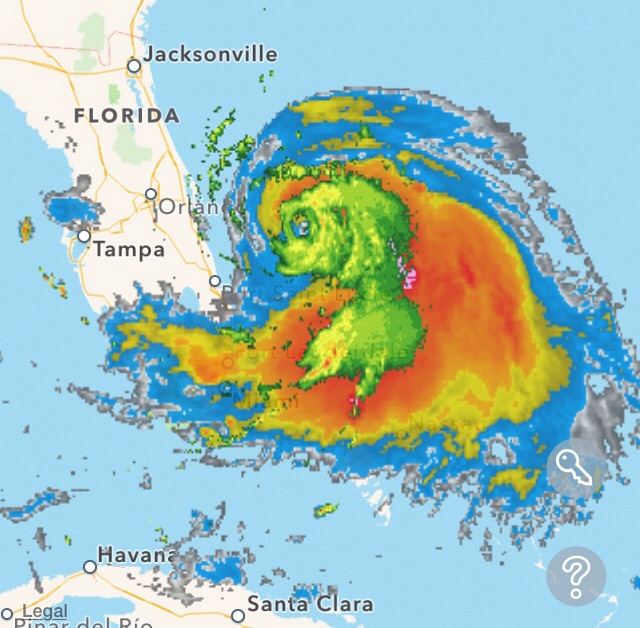
It may be quite a blog folly to represent my highway travel along and through a storm with handheld, geo-positioning technology. But to my mind the visuals of the highway are less interesting -the rush of vehicles, the monotony of pavement. I chronicle the birth of a tropical storm just to the southeast of my earthly coordinates -represented by the blue and white dot in the fourth image. On July three I begin my northward journey via I95, a road which coarsely follows the coastline and parallels the typical path of storms like Arthur. Humans, currents, coastlines, atmospheric pressures all following the same path. 


Outer bands of hurricanes can often fool the spectator. We expect wind, but there is little to none, yet certain quadrants develop stronger storms and in the south they often spawn tornados. It was night, heavy thunderstorms were building rapidly over northern North Carolina, just an hour or so before the Virginia line. Scanning the radar, my concern grew over two cells that were developing just to the east of I95. These aren't the typical tornado radar signatures, in fact they had little in common with those -but something about them was menacing and I pulled off at the next exit ramp to study the situation.

I had the radio on, which was then interrupted by meteorological talk, talk of tornados in this county and that county. At one point they stated that a large and dangerous tornado is on the ground, but then backpedaled, while continuing to wait for reports and issue NWS warnings. If it weren't for my handheld, I'd have to dig into roadmaps to decipher which county I was even traveling through! As it turns out, two tornado warnings (issued when there is a confirmed sighting or when radar signatures suggest a possible tornado) were issued for the region just two miles and ten miles or so to my north, both potentially impacting I95, just ahead of me.

Tension was high, the rain was heavy, and the lightning powerful. I waited out the first warning and then had to make a decision on the second: turn west toward Raleigh, then north (although storms were building fast to the west as well), or go as fast as I can on I95 and hope that I make it ahead of the the warning area. This kind of storm creates a very dynamic, unstable condition that undermines predictability but I had to do something, so I chose I95, as fast as possible, to get ahead of the warning zone. I made it, just as the storms built behind me, the lightning flashing in my mirror.


 My arrival in NYC


The Present Past


As we enter our tropical weather season (with our first named storm, Arthur, not very far from where I stay), I reflect on the damage caused by the meteorologically complicated storm Sandy, who's damage was largely due to its quirky turn made all the more likely by changes in atmospheric pressure caused by rising temperatures and melting ice sheets. 

This past Sunday, a hullabaloo in the name of art and healing with the likes of Patti Smith, Michael Stipe, of course, James Franco, and others took place in the buildings around the beach farm. Used as a promotional image was a photograph of the sand-swamped barracks with ocean and blue sky as backdrop. 

Below, some plantings (and self sowings) made after sand restoration along the Belt Parkway. 


Ahead Of Myself


By the time you read this I will be probably somewhere on the empty highways of coastal Georgia. Before I could leave for this journey to Florida, I needed to harvest as many of the early varieties as possible. Here we have about three dozen Asiatic 'Asian Tempest,' the fiery hot Korean strain that is often extremely fussy to grow.


Until this season, where I have produced more 'Asian Tempest' than any other strain. They held up to early spring better than most of the occasional bolters (I lost nearly all the Turban 'Xian') and then suffered little of the fits and spasms they've had for me over the years. While they grew well, they never get large, most heads rounding about 1.75 inches in diameter.


I brought some eggplant, peppers, tomatoes, and basil to fill the blanks post harvest. As long as it rains, at least once while I am away, these should do just fine.


The beauty of planting between the standing garlic is that they act to break the constant onshore winds that tend to leave little starts like these prostrate.


The bulbing fennel beginning to, well, bulb.


The chard, which I started from old, old seed at least two and a half months ago and planted sometime in mid May, has really taken off. One plant has a stem, or is it a root sticking above ground that is easily an inch and a quarter or more in the round. I clipped all the large leaves over a week ago and already they are producing very large leaves.


In one glance, Silverskin garlic to the left, Creole garlic, fennel, cilantro, romaine, flat leaf parsley, tomatoes, and then at the farthest right Artichoke garlic. When the Artichoke comes out, if it hasn't already, there are tomatoes sitting in front of our apartment waiting to be planted.


Last Tuesday


This came after, when the friends arrived, yet I put this first because, in some fashion, we are traveling out of sequence. This day was a week ago, the day garlic harvest started in earnest.


I pulled most of the French grey shallots, so healthy and green I questioned my timing. This year, my timing is rattled by a cool spring, new plot, and my greatest offense -traveling right in the middle of harvest season. The garlic you see is a Turban strain known as Xian, and I have very little of it. While the harvested garlic plant has very little odor, the naked shallots are pungent as can be.


The Asiatic strain 'Japanese' was completely harvested last Tuesday. I was comfortable harvesting these even a little early as the Asiatic strains tend to demand it or they lose their skins. However, this last week turned out to be exceptionally dry, and another week in the ground would have probably done no harm and sized them up some. A word about sizing-up garlic by delaying harvest: a day or two isn't going to do much, you really need to wait at least four days, or more if possible to really notice a difference. Keep your eyes on the weather and wait another week if it remains dry and the leaves are still quite green.


Of course, since the temperatures have remained below 85 degrees F (probably less at the beach farm), the lettuce continues to produce. The only issue has been the lack of moisture, and my unwillingness to heavily douse the rows because of their proximity to the garlic.


These heads, Romaine and Iceberg, were pulled last Tuesday, before this past dry week, and currently live, roots and all, in my fridge.


The rig, for gas pipelines, encroaches, and was closest last Tuesday.


Yard Bugs


There are bugs everywhere, and especially where there are flowers. I could spend all day trying to capture these impatient sitters. Below a few captures.


Just seems like another carpenter bee going up the wall.


Until she turns around and lets you know she isn't all bluster -queen has a stinger and an all black head. She was out looking for a new spot to nest.


Everyone digs lady bugs, and some of us don't discriminate -we even dig ladybird beetles that hail from Asia. This one hides out under the lily leaf.


Crawling up the other side are the young ones and we celebrate them because they are voracious eaters of soft-bodied insects like Aphids.


Don't be afraid.


A Metallic Green Bee, or what I like to call Christmas ball bees, possibly Agapostemon virescens. You may have noticed the very same bee, here on a Tradescantia flower, flying over the Evening Primrose in the first photo.


Frank Meuschke


Prospect Of Shade


Shade, we love it. It is cooling and pleasant to stand beneath the transpirating canopy, but it also completely changes the world beneath it. The Russian Zelkova trees planted by the city four years ago (has it been that long?) are fast growing and have forced the plants formerly in full sun to be on the move or die trying. Some, like the Phlox seem to relocate their young each year to the east, toward the gap in the trees. Others offer a slow decline, like the yarrow and some asters, where others reach, reach, reeaach as the lily, and some simply disappear like our perennial ageratum. We've moved what we can, having only so much sunny space in the side yard.


Not long ago this area baked under full sun in all four seasons.


New Dawn is known to tolerate some shade, but even our hardy specimen has less leaves than in previous years. It has bloomed, although less vigorously, but will need to be moved to a sunnier district in the Autumn. That will be a tough move for a plant with a thorny trunk the size of my arm.


Underneath the New Dawn, the Spirea. It too will need to move on.


Tickseed, Coreopsis, likes the sun and gets some, a couple of hours worth, as it resides in the shrinking gap between two Zelkovas.


As does my grandmother's tea, which has bloomed more than ever before, a feat for a plant in declining sun and over fifty years old.


And we couldn't live without its scent, which is bested only by the iris and maybe our lilies. But we've no place to relocate it for the next season and may just have to relocate ourselves so it may live on.


The Long Season


It's been a long and slow June flowering season. Many of the flowers that by now would be fried have held on so that many, much like the flowering trees of spring, are sharing space that don't usually find occasion to do so. Our side yard took a couple of hits this winter, primarily the loss of the corner Chrysanthemum and the weakening of the blue flax to just a couple of stems. It's a challenge to keep the sedum from being smothered by taller plants, yet the dayflower and smartweed continue to sprout in the most unlikely locations. I've lost the New York Ironweed, but the solidago and asters hold on. Only a handful of elephant garlic have made it to flower and those were placed in the sunniest locations. The lilies are shooting up, but will flower later, yet if the temperatures remain below 85 there promises to be a pretty spectacular collection of early, mid, and late June flowers all at once.


A Typology Of Scapes


The short-stemmed, rumpled and long-beaked Asiatic (Asian Tempest). 


The double twisting, pretzeling Porcelain (German Hardy).


A variation on the Porcelain (Music).


The three quarter looped Purple Stripe (Chesnok Red).


The corkscrew, double-looping Rocambole (Russian Red). 


And the occasional oddity such as this: the double scaping plant. This Porcelain 'German Hardy' has produced two scapes. But wait, you might say -it was probably a double clove!


But no, say I -they're both coming from inside the same leaf sheath. Only at harvest will the mystery be solved.

There are scapes produced by the Turban and Creole varieties, of which I have no current photos. There are also scapes produced by the Marbled Purple Stripe variety, but they tend to look just like the regular Purple Stripe. And sometimes, just sometimes, an Artichoke or Silverskin will push up a scape of relative insignificance.


A Day In New York


Dunce cap or party hat -depends on you.

Starts with the exercise bike. Seventy minutes later, clean up, feed the cat, and bag the garlic scapes. Subwayed to Columbus Circle and then 45 minutes with a subway barber named Nina. Aim for the middle-of-the-block corner deli for a salad and coffee before the 12:30 phone reference interview for a former student. He never called. One peeyem, conference call with Associate Dean and other stakeholders to express concerns and problem solve regarding upcoming fabrication lab expansion. Hightail to the subway, downtown bound -Union Square. On the platform I get an email congratulating me on meeting the enrollment requirement for my summer class Landscape and Meaning at Art New England -it runs! Subway comes, D train to Herald Square, up-ramp transfer to the NQR for Union Square.

Exit among the hoard of Greenmarketeers, then enter the luxuriously cool lobby of 200 Park Avenue South, up eleven flights to the offices of the Skowhegan School of Painting and Sculpture to aye, pick up my Carrie Moyer print, bee, drop off my alumni donation, and cee, enjoy the company of the fine women who work there. Textzz-zz. Gotta go! Down, now, back through the refrigerated front lobby, to look for Marie who had come all the way to Union Square from Harlem. Why, in such heat? It was yesterday evening's three variety scape harvest from the remotely urban corner of NYC near the ocean to this on the verge chef, definitely author, forager, gardener, blogger and taste-maker extraordinaire. Hand off complete, we shot the sh#t in the exquisitely cooled foyer of 200 Park Avenue South for ten or fifteen minutes, walked toward the Greenmarket, and then I was off to the New York Studio School to meet an old Skowhegan colleague and painter, get a tour of the facility, meet the people that needed to be met, do my sloppy impersonation of an elevator pitchman, shoot the sh#t once again, and then cross wise to the West Fourth subway station for the ride home, where I now sit typing, but no sooner than it took to photograph the opening elephant garlic in the garden, carry in a muffler and pipe for our van, and throw some onions, sausages, and tomato in a pot that may churn into something that looks like dinner.


Storm King


I've been a fan of Storm King Art Center's embellished landscape since I was twenty, a trip inspired by a professor who chased me down after class to tell me all about it. I recall that first visit, an installation by Ursula von Rydingsvard and a team of assistants were actively chainsawing one of her large sculptures. I loved the idea of art made in, of, by or for the landscape.


Above is a sculpture by Barnett Newman, a sculpture that takes advantage of Cor-Ten steel -its red rust inserted here into a haze of lush greenery. You will find the contrast of rust and vegetation again and again at Storm King and most sculpture parks, but rarely done as well as Newman's 'Broken Obelisk.' Its siting lays bare an intimate dialogue between Modernist geometry and formal Wilderness, a contrast more surprising than Houston's Rothko Chapel siting (admittedly, one I have not seen in person), and a work worth experiencing as much as any other at Storm King. Its power resides in its planes concentrated at the point between two pyramidal forms, one darkened in shadow and the other lit by the sun. The work displays exceptional poise, balanced as it is at this point, but its formal grace is interrupted by the jagged, "broken" top plane which roughly mimics the angle of the base pyramid, forging an undecipherable relationship between the grounded pyramid and the precariously balanced, broken obelisk. That uneven, broken edge disturbs the precisely manifested union, threatening to topple the obelisk. The implicit movement creates an experience of inherent kineticism, a monument about to fall.


Andy Goldsworthy's 'Storm King Wall' is as innocuous as any New England dry laid stone wall as it approaches the body of water, but then emerges a serpentine folly on the other side, rising up into the forested hillside.


This playful work heightens an awareness of the frivolity of artistic labor via the urbane interest in a landscape demarcated by hard won assemblages of stones dispatched from difficult fields.


Zhang Huan's disembodied Buddha head, glimpsed while climbing a minor hill, first suggested to this painter my memory of a Philip Guston work, below. A head not fixed, its connection to the earth concealed by lushly growing field plants, but one in motion, rolling uphill. It is a sight both haunting and comic.


Which is the case for many of Huan's pieces and yet their humanity is inescapable despite the sculptures' grotesque distortions. I find myself applauding their perverse acrobatics.


At play here is a sensibility for relic and ruin, sited in landscape, and excited by landscape. Huan's broken monuments suggest ancient religious ideologies breaking under the force of cultural upheaval. This is complicated by placement in a Western landscape where the sculptures become a ruin enhancing the romantic aura of Storm King's Hudson Valley site. The ancient Chinese culture transmogrified by these works is conflated with Western imagery, bridging the destructive aspects of Cultural Revolution with the exertions of Western political, economic, and cultural influence.


In the southern reaches of the five hundred acre campus is one of Storm King's few projects that actually is formed out of the land -Maya Lin's "Storm King Wavefield." Here a sea of grass becomes an illusion of fluid rumpled by the transference of energy through it, a display that would be menacing if its artifice wasn't so apparent. The waves have direction and when seen from below, they subtly evoke the surrounding mountains. Lin's interested in wave forms, although concocted from scientific observations and technological means, generate an abstraction that is most analogous to a raked zen garden. The view from the amphitheater encourages this comparison because it enables you to take in the whole field, much as we view a zen garden as a whole, from the outside. 


But when drainage permits, visitors are given access (we were not) to the field, offering an uncanny experience of a landscape of perpetual, immobile waves. One can travel the length of peak or valley, or tack diagonally, cresting and falling with each "swell" so that we become the motion to a fixity of earthen waves. 


Evening At The Beach Farm


The iceberg is shaping up.


And the romaine ready to go.


I have only a few Artichoke garlic this season, but some are sizing up nicely.


I only planted a handful of French Grey shallots, and they looked pretty meek in early May. Now they've come into their own and are looking strong and healthy, but I'll have only enough for my cooking.


From this angle the new plot looks garlic-full, if a little sparse. See the shallots at the edge, right side.


Some of this season's Creole strains, "Creole" on the left and "Pescadero" to the right. Always a challenge to grow, and even more so to grow large, these plants happen to be shaping up as well as any I've grown. Dare I say the best, yet, based on their stem size. Now, to avoid the Creole curse -witches' brooming.


From this point of view, you can see how much garlic didn't survive the spring season. All that space is now planted with bulbing fennel, lettuce, swiss chard, and parsley. After the Turban and Artichoke strains are harvested, tomatoes and peppers will be planted in their place.


Over in the other plot we have the tangle of high season. Hidden in this mass is the nearly ready Asiatic strain "Japanese," but also Rocambole "Russian Red" and "Killarney Red," Asiatic "Asian Tempest," Porcelain "Music," "Georgian Fire" and "German Hardy," Purple Stripe "Chesnok Red" and Marbled Purple Stripe "Siberian."


Now the harvest game, contemplating the right moment for harvest and then seizing it. Expectations are for a season later than usual, which is good because I will be away in sizzling Florida for 10 days come late June. I do expect to have the Asiatic, Turban and hopefully the Artichoke all harvested before I depart.


And of course, there are scapes. I will be plucking them over the next few weeks, first the Turban and Porcelain, then the Rocambole and Purple Stripe. I may just keep some on the plants for the visual, but also to see how that affects size and longevity of storage.


So we grilled our first trimmings, but couldn't drum up too much interest from our guests.


As the sun settled down, I took a good, long look at the two gardens, then harvested romaine, ruby red, and one iceberg lettuce head. Although I am not growing a substantial amount of garlic this season, I have enough to offer and it's looking quite good. I am excited to bring it to market via Hudson Clove, and will probably offer labeled bundles as I have in seasons past. The cure will take place in the studio where there is more than enough room for this quantity of bulbs and the humidity and temperatures are the best of any option.


Approach Of Summer


I made a mid day trip to the beach farm to harvest lettuce for the coming week and, as it turned out, to head off the growing crabgrass that loves eighty degree days and dry conditions.  I planted some of my remaining romaine and chard, although it is awfully late for these little starts. I expect they will bolt before they size up.


Milkweed grows at the edge of our plot, and I let it for the good it does and the harm it does not.


The garlic is now sliding into its summer appearance (not unlike flower garden in July), a tangle of less turgid, slowly yellowing to browning leaves. Please note the UFO in the upper left, above the neighbor's fertilizer bag.


And, as expected now that June is upon us, the scapes are pushing up, some more advanced than this Rocambole. This Friday I will harvest (and grill) our first scapes of the season.


The earliest of the early, the Asiatic "Japanese" or "Sakura," is cloving. Before this process, spring garlic looks similar to "green onions." These and the "Asian Tempest" will be ready in a couple of weeks.


Some romaine lettuce I've yet to harvest. I will probably take this on Friday. Romaine holds up to the heat well, and I think it makes it taste better.


This is a new type of romaine lettuce, flecked with red on bright green, that I grew from seed. 


It is awfully hard not to harvest these big leaves from the Iceberg lettuce. Inside, the head should form, but I've never grown this type of lettuce before and am not feeling its potential to do so. I may have to harvest this before it wants to bolt.


In the other plot there were three heads of what I mistakenly thought of as bolted lettuce. I pulled them up and threw them on the weed pile. I found another and tasted a leaf, and then it hit me -I've planted escarole! I left the three to wilt on the weed pile, figuring it a wash and left the fourth planted. After all my work was done I tasted a leaf of the still planted escarole, a leaf not all as bitter as expected. I grabbed the wilted from the pile and began to rinse the roots of soil, then pulled the remaining one and did the same, and bagged them all. Within the hour the escarole returned from the wilted dead, completely rejuvenated, the very Lazarus lettuce you see here.


And, in a neighboring plot, the one turned over by its new gardener after I planted peas, potatoes, and greens, there is a growing vegetable mishmash from which I harvested some pea shoots for today's salad.