Solidago sempervirens on Flavor Street (33rd between 2nd and 3rd Avenues). A subtle reminder that good things are happening in Sunset Park. Come on down (or up) this weekend for GO Brooklyn. And, yes, my studio does smell like a ton of garlic.
Hudson Clove Live
Garlic ordering is on. The HUDSON CLOVE tab on the top left is now live -taking you directly to my garlic site. The site is functional, although a work in progress, and you will be able to order and pay through the site.
My mission here is to introduce into NYC the variety of organically-grown garlic that is available in other regions of the U.S. and world. At NYC Greenmarket, you can buy two kinds of garlic -mostly conventionally grown Porcelain, while Keith's farm sells an organic Rocambole. No one grows and sells Silverskins or Artichoke, Turban or Asiatic -but they should! You want Turban and Asiatic because they will be cured earlier than anything farmers currently bring to market. Artichoke and Silverskin because these will last a long long time in a cool spot in your apartment and that means fresh garlic in the winter and maybe spring. The reason farmers aren't growing them is mostly a matter of practice, but also a matter of education and to some extent the difficulty of growing these varieties at scale. Ultimately, I would like to see my crop produce seed standard bulbs, so gardeners can buy seed bulbs that are already acclimated to our climate.
If you are willing, consider your purchase as a way to pay for last season's seed or a way to pay for half of this season's seed. Maybe you would rather pay for a portion of this season's acreage? Your bundle will pay for 10% of a year's rent -that is significant! Whatever your reason, this small amount helps support my chance to grow on a real farm with perfect soil for an even better garlic crop next season.
Whew. Okay, the shop is open. We will have a pickup weekend this Saturday and Sunday at my studio during the GO weekend if you would rather not pay shipping and/or you would like to see my paintings. We will be open from 11 am to 7 pm, both days. If you order via our site, I will email you directions for the pickup. Or, you may simply come by and if I have any remaining garlic you can purchase it. Thanks!
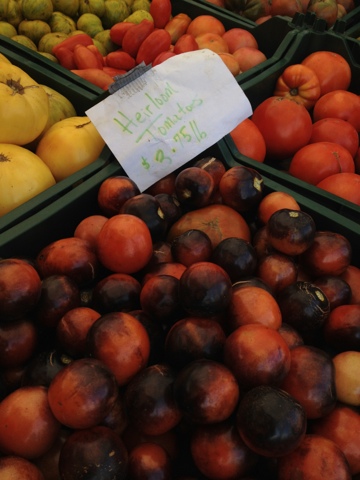
Indigo Rose Tomato
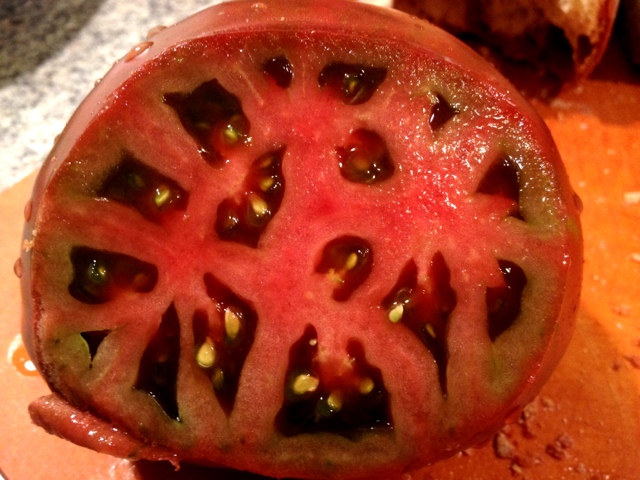
These are my beach farm grown "Indigo Rose" tomatoes. Many have asked how they taste and the answer is okay. They are plenty juicy, and maybe this is killing some of the flavor. They do have a very pleasant acidity and little in the way of sugar. I will grow them again and toss them with "Sungold" cherries for color and sweetness.
More than one farm was selling these at the Grand Army Plaza Saturday market. They all labeled them heirloom. Seems anything not looking like a dull red tennis ball is an heirloom these days. But for the record -these aren't heirlooms, unless your grandfather is a university in Oregon.
September Peaches?
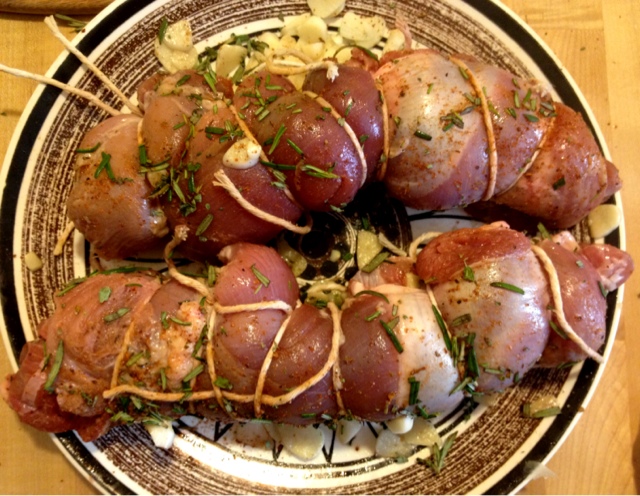
Garlic Stuffed Turkey Thighs
It was nice to chop my garlic today while listening to music. It feels like a needed pause. And the garlic? I've had little opportunity to cook, so it is incredible informative to actually peel it. I'm cooking only with culls -these are bulbs that I have found to have one dried clove or the occasional rotted clove that I take out of the marketable supply. There's been several this season thanks to a very wet May and incredibly dry air this summer.
This afternoon these two turkey thighs, stuffed to the hilt with garlic, rosemary and others will be grilled at my friend Mark's place. It will be alongside several other meats brought by others.
Looking forward.
Return To Garden
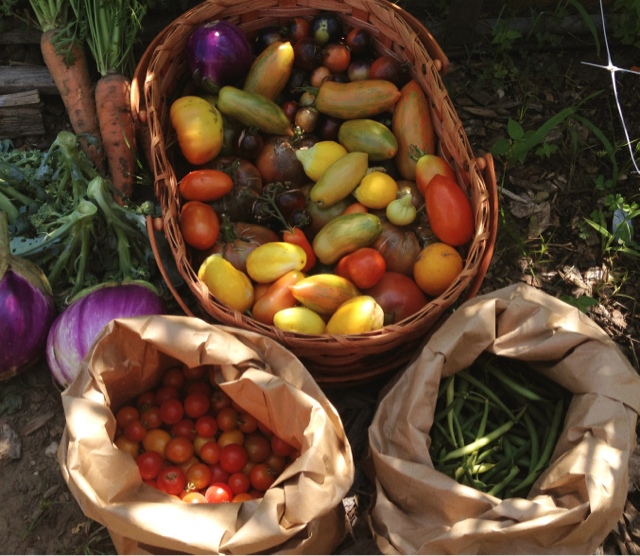
It took me four days to get to the beach farm after our return to NYC on Sunday. When I did, it would have been hard not to be disappointed by the giant eggplants (although beautifully colored), the mildew beaten cucumbers (hardly a leaf in sight), the swollen French beans, or the dropped husks of rotten tomatoes.
So I set to work to get things back in order. Tomatoes were picked, green beans picked or pulled, broccoli cut (horribly full of harlequins and cabbage worms), lettuce, fennel, and brassica seedlings planted, and carrots plucked from the soil.
All in all a good haul. Then I left, unsure when I will be able to return.
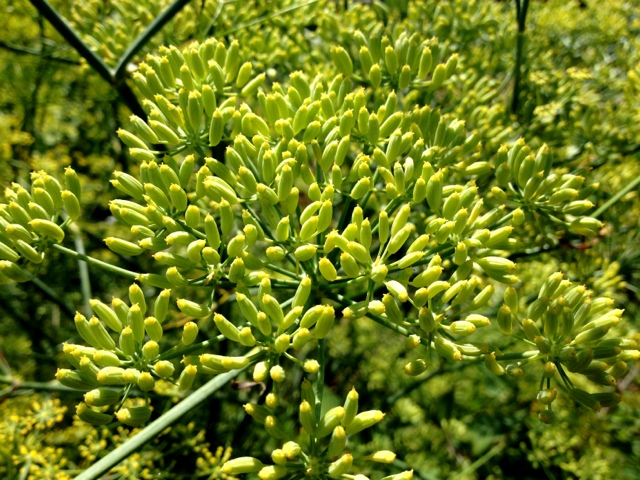
The herbs are at their peak. All the flying creatures love the seed fennel. Only the Thai basil is seriously flowering.
Stunning and powerfully-flavored.
And I had tomatoes for dinner. My first this season, just as everyone else begins to tire of them. Black Russian still favored over Black Krim.
Shameless Self Promotion
A couple of events I have going on over the next month, this September, that you may want to check out.
The first is GO, on Saturday and Sunday September 8 and 9, from 11 am to 7 pm. Go is a Brooklyn-wide open studio weekend and nomination opportunity for inclusion in a Brooklyn Museum exhibit this winter. Since this open studio is borough-wide, there are probably a couple of thousand studios to visit. Bushwick has the BOS, Gowanus has the GOS, Dumbo has the DAF, the Brooklyn Navy Yard has its BNYarts. Why not go to a new neighborhood and see something different? See the art in your neighborhood and then come to Sunset Park!
Sunset Park has several artist studios to see between 39th Street and 32nd Street (the Chashama space is way way down on 59th Street). We have a bike rack in our building (55 33rd St.) and the D/N/R stop is a short distance away at 36th Street and 4th Ave. We also have a diverse, bustling community upslope (we're on the waterfront) that everyone should visit. Explore Sunset Park's 5th and 8th Avenue for a Chinese lunch or Mexican dinner. See Greenwood Cemetery, just a few short blocks away. Go bowling, make a day of it!
If you register on the GO site, you can nominate up to 3 artists for the Brooklyn Museum exhibit once you have visited at least 5 studios. It's easy, and we'll all have instructions as to how.
AND...
I was invited to participate in a project at the Dumbo Arts Festival on Sunday, September 29. Artist Heather Hart is putting together a project called Barter Town (Trading Post X: Tomorrow-morrow Land). I will have a booth where I will be displaying and discussing anything and everything about (yep, you guessed it) garlic!
I have a well-preserved specimen of Allium sativum ophioscorodon var. porcelain, roots to bulbils, that I planted in Minnesota last September. I will have varieties on display, seed stock versus food stock, immature bulbs, bulbils, American elephant garlic and Chinese elephant garlic, and more, and will try to answer any question you may have about garlic. Since this is Barter Town, no money or promises of money may change hands. Nothing will be for sale. You may barter your time, your email (for Hudson Clove updates), or your patience!
Of course, there are lots of other things to see in Dumbo normally, and certainly during the DAF. See the gorgeous glass-shrouded carousel, get chocolate, eat ice cream under the Brooklyn Bridge, crap -go to Starbucks.
It's autumn in New York City. Get out and enjoy it. I'll see you there.
Quoddy Bog
How many of us have explored a bog? The Irish landscape gave us the term we use often, but we barely appreciate its roots.
A bog like this one requires a boardwalk. There's hardly anyone light enough to avoid getting "bogged." This landscape expressed a surprising shift in scale unseen in other environments. At once you are viewing the trees, shrubs, and moss. Get closer, you see even more.
The dominant colors within the bog are crimson and chartreuse.
Ribs add rigidity to the rather phallic structures of Pitcher Plant, Sarracenia purpurea.
Hairs point downward on the interior throat, making it easy to enter, but hard to leave.
An ant investigates at its peril.
The Pitcher, like all pitchers, eventually fills with liquid -in this case, rainwater.
The trapped insect falls into the liquid, where it is digested by enzymes released by the plant.
Statuesque flower of the Pitcher Plant.
Seeds.
Sundew is another species of insect digesting plant.
There are two varieties of Sundew in the Quoddy bog. This one is known as the Round-leaved Sundew, Drosera rotundifolia.
Insects are drawn in by the sparkly, sticky fluid on the tips of hairs. Once there they become trapped and digested. The leaves do not close on the insect like the Venus Fly Trap.
In the areas where rain had ponded on the surface, the other Sundew.
Drosera intermedia, or Spatulate-leaved Sundew.
Which happened to be just about to flower, although just out of reach of my camera phone.
The dead sphagnum layered beneath the surface is several feet deep, is oxygen and nutrient poor, and highly acidic. There is no ground water in this substrate; the bog receives all its water from rain and dew alone. That these plants evolved the ability to ingest nitrogen, phosphorous, and other nutrients from insects is rather incredible.
There was some blueberry (and cranberry too).
Black Crowberry, or Empetrum nigrum, was abundant (edible fruit, none present).
The rubus-leafed plant to the upper left is called Baked-apple Berry, or Rubus chamaemorus. Yes, these berries are edible and, you guessed it, are said to taste like baked apples.
Up next -peat.
Cardinal Matters
I'm well aware of the disdain (see Garden Rant) and the rhetoric (see Michael Pollan).
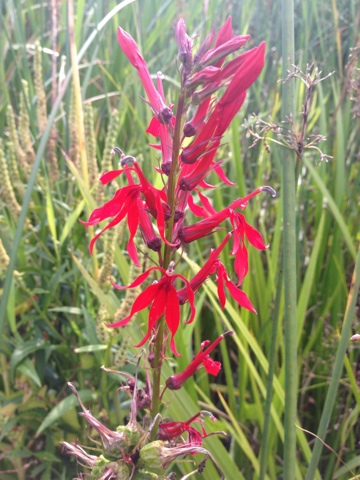
Still. As I look upon this cardinal flower, Lobelia cardinalis, I immediately, emotionally respond to its presence.
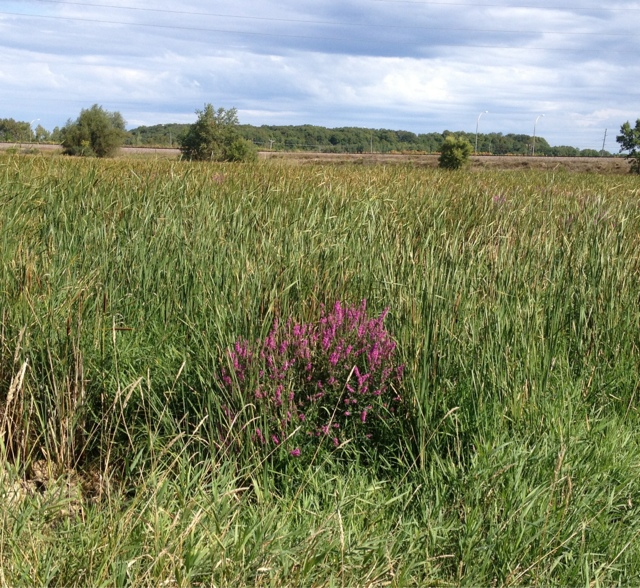
On the other hand is purple loosestrife, Lythrum salicaria. It's pale purple wands are pretty, especially so en masse, which is often how one finds it, but hardly stunning. Is this a learned response? If purple loosestrife was a native plant, would I espouse it's regal nature?
I do not know. What I do know is that seeing cardinal flower marsh-side is rare, yet finding purple loosestrife is becoming exceedingly common in Hennepin County ditches, wetlands, and cloverleaf water basins.
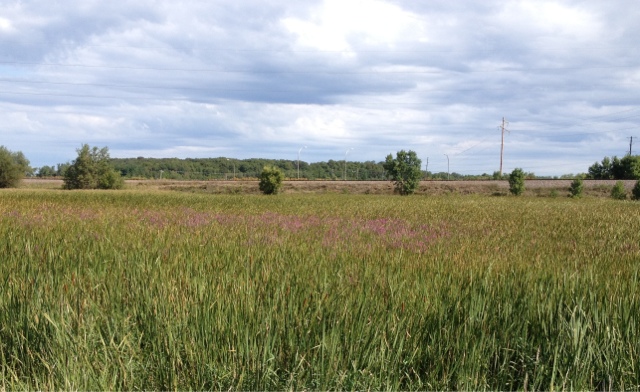
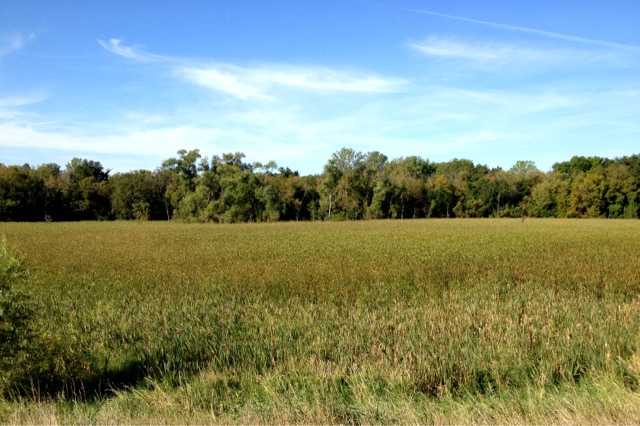
Rex likes the purple loosestrife, he says it's pretty where the marsh is just a wash of green. He believes the loosestrife cannot outcompete the cattails and rushes. But I doubt that, as evidenced by New York State's marshes and wetlands. Those must have once looked like Minnesota's, but now many are nearly a monoculture of purple loosestrife. After bloom in July and August, the wetland becomes a wash of dismal brown, whereas Hennepin County wetlands offer a kaleidoscopic interference of green and gold.
I'm not sure people care all that much. Like Rex said, it's pretty, and it's spread appears incremental, hardly noticeable. The government has policy, it is a known invasive, it is illegal to harbor it on private property (this is where tongues tingle with politi-lingual fascism), and it's hard to control. And maybe, maybe, an appreciation for rarified things in life is an elitist affair. And maybe people, humanity, has a thing for the strong, aggressive, and adaptable in life. Maybe.
Cardinal Matters
I never did post the cardinal flower images from my Carmans River trip last August, so this post from my other blog will do double duty today. Minnesotan wetlands do not get the attention they deserve, certainly not from NewYorkers (how could we know?). I've hardly delved into their living beauty, but in short...
I'm well aware of the disdain (see Garden Rant) and the rhetoric (see Michael Pollan) around native plants, ecosystems, and plants termed 'invasive'. I've tried to understand both positions over the years.
As I look upon this cardinal flower, Lobelia cardinalis, I immediately, emotionally respond to its presence. I wonder if I'm the only one who has noticed this stand amongst the grass and cattails.
On the other hand is purple loosestrife, Lythrum salicaria. It's pale purple wands are pretty, especially so en masse, which is often how one finds it, but hardly stunning. Is this a learned response? If purple loosestrife was a native plant, would I espouse it's regal nature?
I do not know. What I do know is that seeing cardinal flower marsh-side is rare, yet finding purple loosestrife is becoming exceedingly common in Hennepin County ditches, wetlands, and cloverleaf water basins.
Rex likes the purple loosestrife, he says it's pretty where the marsh is just a wash of green. He believes the loosestrife cannot outcompete the cattails and rushes. But I doubt that, as evidenced by New York State's marshes and wetlands. Those must have once looked like Minnesota's, but now many are nearly a monoculture of purple loosestrife. After bloom in July and August, the wetland becomes a wash of dismal brown, whereas Hennepin County wetlands offer a kaleidoscopic interference of green and gold.
I'm not sure people care all that much. Like Rex said, loosestrife is pretty, and it's spread appears incremental, hardly noticeable. Minnesota government has policy, it is labeled invasive, it is illegal to harbor it on private property (this is where tongues tingle with politi-lingual fascism). Yet maybe, maybe, an appreciation for rarified things in life is an elitist affair. And maybe humanity has a thing for the strong, aggressive, and adaptable.
Maybe.
Quoddy
Time being what it is, several images and a few thoughts are all I can put to post. Enjoy. Visit the northeastern most region of Maine sometime. As raw, wild, yet accessible, as the east coast gets.
Sun to the south east, we begin our hike.
In just a few steps we are in a balsam fir and white spruce forest, moss floor dappled, stunning.
Where the sun made headway, woodland asters were in bloom.
And recent rains had inspired mushrooms to fruit.
Is there no better way to see mushrooms than floating above a mossy carpet?
There were several plots of thick clover cover deep in the woods. It appeared out of place, and I wonder if it has anything to do with this.
Out of the woods, onto the cliffs.
I believe a cranberry flower (crane -berry), cliffside.
A memorial, a mystery, and a severe case of deja vu. We emerged from the forest onto a promontory full of drying grasses and a green, leafy plants in flower. To the north, a little bronze plaque memorializing a woman, who's name escapes me but had a distinctive Slavic sound (ys, zs, cs, and ws), adorned a boulder facing the sea. The flowering plant, again, appeared out of place. It looked like celery! Tear and sniff, too strong for celery, but Lovage? The plaque said that this was the favorite spot of the woman it memorialized. Lovage is a favorite of eastern European cooking. Could she have planted it here? Was it her favorite place, not only for the sea and cliffs, first sunrise in the east, but also because her favorite pot herb was growing rather wildly? I have no idea, but then, a consuming feeling as if I had been in this exact spot before. What is this all about. I had intended to make my way up the coast for years, but never made it past Schoodic Point. Had I encountered a similar cliffside and Lovage growth further down east?
Deaths from ocean spray whipped up by the Groundhog Day Gale of 1976.
While the invasive purple loosestrife was in bloom, so was the fireweed, Epilobium angustifolium.
A spectacular alternative.
Old Man's Beard, Treemoss, Usnea spp. -a symbiosos of fungus and alga.
Again, Indian Pipe, pearlescent white atop green velour.
A spectacular alternative.
Off to the bog, we rested, lounging lengthwise down the planks through a wetland. While there were several benches along the coastline, there were none within the woods.
Moss-blanketed forest with emergent Indian Pipe, Monotropa uniflora.
The sun now toward the west, we left Quoddy Head for Lubec -population 1359, bridge to Canada, and three eateries. Did you know that there are three spices in Maine? Salt, pepper, and fried. Keep it simple, stick to Maine's natural resources -lobster, potatoes, milk, blueberries. Although they do breakfast well, bring your own coffee.
Next post -the bog.
Autumnal
There has been a heavier heart this big woods trip. Rex likes to say that there are only two things in nature -chaos and chance. I like to say that the only thing between civilization and chaos is maintenance.
From the very first day, we've been at work on the house as rot has set in. We stem the tide and wait for next summer.
The air has been cool, and I have seen the leaves changing, day to day.
This morning, Rex and Betsy left at 5:30 for the Mayo Clinic. I left for breakfast around 6:45 and saw Autumn's first mist on the marshlands.
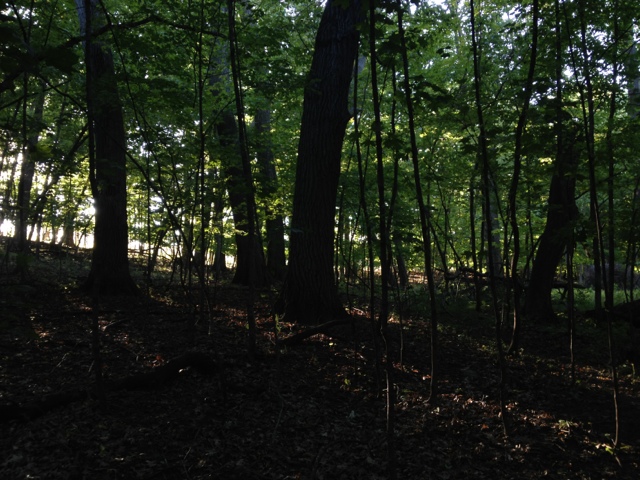
The trails have not been worked, and have not been walked. There's no greater sign to the changing of things in the woods. Oak wilt has taken out more of the red oaks, and old falls have not been sawed. Nettles grow, obscuring the path for the first time in my decade of coming here.
Indian Pipe appears ghostly for the first time.
The bridge is missing planks, and most have rotten through. It is now dangerous to cross the marsh unaware.
Chicken, Day 5
Chicken, Day 4
Ellen has been encouraging me to eat the young chicken. This is good, because we're leaving in a day or two.
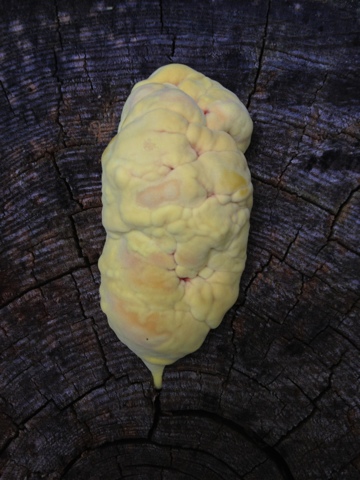
I haven't checked this morning to see if the mushroom people collected my laetiporous yesterday, but I suspect they honored my sign. After all, we supplied them with their purple ribbon chicken two summers back.