For Peat's Sake


I found this opinion piece in the NYTimes well-intentioned, but silly. I'll start with the laughable notion that anybody is really using peat for ground cover. Dry as a bone, it would blow away at the slightest breeze, it is nearly impossible to wet down with a hose, and it acidifies our soil that already leans that way. You might add some to the blueberry patch soil or your new rhodi bed, but it's hardly a common purchase and hardly something you can "fork."

Oh, wait -yes, the way we really use peat is as the major component of potting soil and starter mixes. Yep, but that wasn't mentioned at all.

If it weren't for the convenience, I wouldn't use peat one more time. Maybe I will use compost, without peat, for starting my seeds next year. If I fill any pots, I can do it with compost. It'll work, it'll be fine. We got used to peat because it holds water well after it has been wetted, is light weight in the sack, and it's ubiquitous in the marketplace. But it's time to stop, not because we must, but because we can. Compost is naturally full of humus, which is just as friendly to seed starting as peat-based starter mixes. I mean, we're not professionals, right? We don't demand 100% germination rates. And can't our potted plants survive a lower water-holding capacity soil mix? Sure they can, we've got drip systems attached. As for weight on our rooftops and terraces? How much more weight is a comparable compost mix compared to fully wet, peat-based planter mix? I cannot say, but we should find out.


Early Bird


This morning, while stepping out to move our vehicle, I noticed a group of house sparrows, fat as they are around here, fluttering about the shrub rose. I can't recall ever seeing any birds in the garden, so I thought it odd.

Keeping to the driver's seat, I then watched them move over to the New Dawn climber, this time pecking at the tips of newly formed rose buds. Aphids, of course. But why would these birds suddenly be taking an interest in aphids? They are always there, but again, I have yet to see any local birds care to be about these thorny bushes.

Then it hit me. They, the proverbial canary, are reacting to the utter lack of water in the neighborhood. Aphids are, not unlike last summer's tomatoes in that nasty hot and dry spell, a water source in times of scarcity.

We are in the midst of a garden drought -my coinage for drought conditions gardeners face when it doesn't seriously rain for such an extended period that we become deeply concerned yet the greater population has not begun to notice. With such glorious sunny days and full reservoirs, what's to notice? But a gardener's drought is often a farmers' drought, becoming a local foodie drought. And we wouldn't want that. So, even though no significant rain is forecast for the next ten days, I for one am hoping that forecast is mistaken.

Sparrows doing their good work.


Painting Tab Now Live


I was going to wait until summer, but why wait? I can't believe I didn't think of this sooner, either. Well, Blogger has updated the looks of their templates and I've learned some hacks to make it appear more as I want. It's not perfect, but it's free, it re-sizes images automatically for mobile, and it is way easier to update. My art website, with its complex ftp and wtf, I never wanted to update -so good riddance. Blogger -may you live long and prosper.

The NEW PAINTINGS tab, above, is now live and will be updated as I paint. I may also begin blogging on art, keep an exhibitions page and other news.

Which Way The Wind Blows


This wind, especially in the open space of the beach farm, is rough. It underscores another problem quietly lurking -drought.

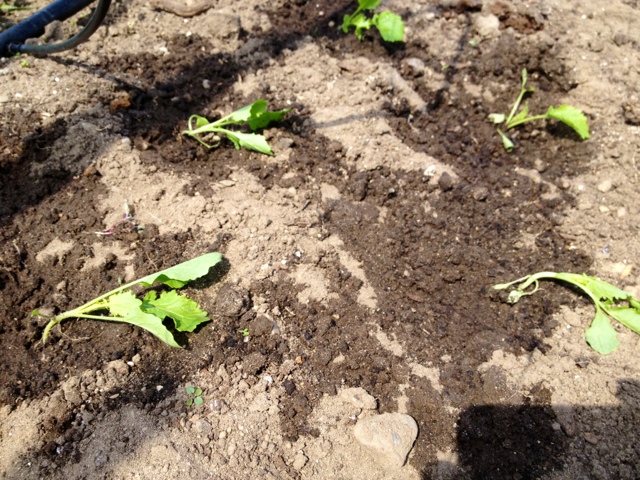
I'm planting broccoli rabe at the beach farm this morning. It's ready to go, although this wind and the fact that the Fed hasn't turned the water on, will give the young starts a tough time of it.

It's quite dry here too. Digging down, I don't hit cooler, semi-damp soil until about 5 inches. The rabe, I can hope, having doused them with a bit of drinking fountain water, will make it through the next 24 hours. Hope isn't enough, so I decided to hold off on most of them.


Open Letter To Those Requesting Images


Hi (name withheld),

Thanks for visiting my blog. I have worked several years on it, and I take it quite seriously. Everything that is mine is copyrighted.

As you might imagine, bloggers like myself get several requests each year for pro bono usage of our work. The reason is that authors, organizations, companies, and governments who request these images do not want to hire a professional to do the image work they require. No doubt, that would be expensive and possibly cost prohibitive.

So it is that searching for images online has become normative. So has stealing those copyrighted images. I am sensitive to you using the phrasing "before I do the ol' copy and paste" in your email. This would be a mistake for several reasons beyond violating my copyright.

Many of the images I have posted in my early years as a blogger I do not feel are up to publishing standards and I would need to do an amount of post-processing to achieve my standard for that purpose. Anything with my name on it, whether cited or not (I can see my images from a mile away), must be up to my standards.

I went to art school and have attained my masters degree. I am a professional. I am still paying for my education through loan payments. In other words, even if everyone who needs images for their productions regards my work as casual, and therefore should be given away for free, or for the price of flattery or attention, those individuals should be aware that it has a cost. This cost is beyond taking the picture, beyond the cost of the camera, beyond the post-processing time, as there is a history of investment in my ability to capture in images something meaningful, which clearly you respect since you thought it worthy of your project.

Finally, I use the Internet to present a portion of my work, but this doesn't mean that I ascribe to the creative commons idea for everything I do. I will consider a sliding scale for imagery needed by non-profits, governments, and publishers. I appreciate the hard work (and low pay) of non-profits, and I have in fact worked for more than one. Understand that I simply cannot undervalue my work in this manner.

Good luck with your project -nature guides are of high value in my book, and worthy of excellent imagery.

Sincerely,

Frank 

On Your Mark, Get Set, Tomato


I rose too late on Tuesday to get out for the biweekly meeting of volunteers cleaning the wasted woods of Prospect Park. I actually miss it. Mostly because of the social aspects of a great group of people in an unsavory cleanup environment, which can lead to some clever humor. Well, I had an hour to kill before work, and behind on my tomato seeding, I chose to knock it out that morning.

I had no pots and little in the way of paper tubes, but many cereal boxes.  I am a little distrustful of recycled chipboard, a mystery concoction from far away lands, but went for it anyway. Each was large enough for three or four seedlings. I particularly enjoy the barilla box with the single mezzi rigatoni on its end, wide and deep with the little window on its side for viewing root developments (wink).

Outside, on their bake sheet, I filled each box with the planter mix -a mix of composted wood, peat, and perlite. There may be a more earth-friendly alternative, but I haven't found it locally. All in all, about 50 tomato seedlings to be. I can only plant about twelve, so I will be handing out the rest to friends and gardeners. I do have a few interesting new varieties this year -Velvet Leaf, which is more about the foliage than the 2-inch red tomato, and another called Indigo Rose which is really leaning toward a black-green tomato. Hillbilly and Pineapple are both intended to replace my beloved German Striped which I have difficulty locating. Black Krim is, I'm assuming, much like the Black Russian that I also seeded. Speckled Roman is a long roma-type with yellow-orange striations. A Yellow pear type as well, along with several others I grew last year. I think it will be a good year for tomatoes.


I See The Farm And It Is Us


This building sits directly across from the building that currently houses my studio. It is being renovated as I write. Incidentally, there is much license taken with this BQE viewpoint, which shows it quite apart from the building. The BQE westbound is three lanes and one sidewalk away from those windows.

It is told that this building will support an enormous rooftop greenhouse. BrightFarms, pretty much the only rooftop greenhouse game in town, is looking to monopolize the NYC market. Much as I suggested in this post, soon we'll be complaining that corporate farms look like rooftop greenhouses instead of mega-tractors on 100,000 acres. It is hard for me to imagine, at this early stage, how this transformation could go terribly wrong, but I can very much see the demise of local dirt agriculture that focused on similar crops -namely those that grow well in hydroponic greenhouse environments -tomatoes, basil, peppers, cukes.

Isn't farming more than fast and easy food. Has "locality" taken to the extreme missed the point of the local foods movement? Or am I just a sentimentalist with a taste for the culture and landscape of the farm. Hydroponics have always seemed to me more like science than great food, like a preparation for our inevitable flight through the light years of space. I don't mean to be negative, but understand, it's just that I have a great affinity for dirt (that's NYer for soil). What do you think?


Goosed


Our greens have finally exploded after this week's rains.

Potted parsley, with a winter's worth of roots, never died for lack of  cold. I transplanted  the several plants into beach farm soil.

What's wrong with this picture? Remember the corn gluten meal I put down for early spring nitrogen and weed-suppressing action two weeks back? The brand I bought was pelletized, so little kibbles were spread all over the garlic beds. You are supposed to water it in, turning pellets into a dispersed corn mush, but our water hasn't been turned on and it didn't rain for at least a week. So, what happened?


Geese happened. They are all over the Rockaways. They swooped in, eyeing that bright yellow meal from above. They probably ate it all up not long after I placed it, so the corn gluten could not do its job. Meanwhile, the geese trampled some of the smaller garlic, ripping leaves, squashing new growth, pecking holes in the ground, and pooping green and white.

And the weeds? They sprouted and survived. In fact, on this last trip I was amazed at the number of warm-weather weed sprouts -particularly the smart weed, mallow, and lambs quarters. Corn fed goose. Sounds tasty.


As The World Grows


These have been unproductive days. If I should ever be able to marshall the powers which control my attitude towards work and productivity (I suppose we call that discipline), I will be a huge success. Until then...

A brief visit to the beach farm, tomatoes yet to be seeded. A visit to the offices at the studio to discuss upcoming changes, where nothing's changed, and finally, some hours in the studio where little was accomplished. Ball dropped, I went to the grocery to pick up some pork shoulder for tacos. In the oven now, I simply wait, while considering how enjoyable watching old episodes of Twin Peaks might be. 

For tonight's tacos, which I am sure to enjoy, I must thank Marie of 66squarefeet. No one person in recent years has influenced the way I think about food as much as Marie has through her blogging. I cannot say that I am a better cook (in fact, I might be slipping for lack of time), but what has happened is an awareness that has invigorated food itself -the process, the presentation, the representation. I think that's remarkable. 


Broccoli rabe or cima di rapa, however you like it, growing fast now. But still too tender for the beach -its awfully windy there. Roots are beneath the wooden box now. Next week I will plant it out. It is a delicious green at this stage.

Fennel, the Greater. Fennel, the bulbous. Slow grower, but competent -no fuss, so far.

The other fennel for seeds -Fennel, the Lesser. Here, a seed capsule slowly casting off. I suspect this plant will become a weed and I will be responsible for creating a new foragable species in the Rockaways. Worse -I hear chefs want the pollen, not the seeds. Either is good rubbed all over pork. I use it liberally in Italian dishes.

The lettuce. Both new to me, well, at least since my last attempt, at the unaccomplished age of 25, in a wet and sluggy garden during my brief stay in Portland, Oregon. Butter and romaine here, to be transplanted into the tomato beds at the beach.


Moving About


So that I could move about, I went out and moved some perennials about. The adjacent utility poles have been removed, so the side yard is now being incorporated into the new front yard. I gave the surviving perennials more room (more space will help you think this way). The Threadleaf Ironweed was placed much closer to the sidewalk because it is drought tolerant and late blooming. The path was re-curved toward the new, long front yard with an eye for using the gate instead of climbing over the fence.


Threadleaf Ironweed roots

First Thunderstorm?


Maybe. And headed this way. Caught off guard, I must run home from the studio to put the cold frame lid down over our delicate seedlings. *Update* Seems a radar phantom storm. Not much happened here.


For The Birds


There is a rental dispute among what appears to be three species of birds above our side yard. They have pecked holes in the sill of the neighbors apartment. Now 6 birds are fighting with bedding materials in their mouths. I think the starling will win for size, but the house sparrows are pretty rambunctious. Meanwhile there sits a completely empty birdhouse just beneath them.


Germinate This


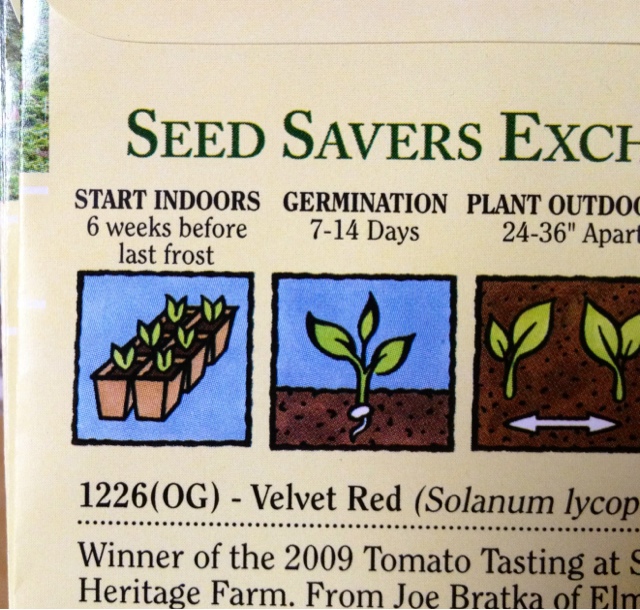
All of my seed packets for tomatoes, from several different sources, say to plant the seeds indoors 6-8 weeks before last frost. Now, this year that could hardly make any sense, but even in normal weather years, if I was to put my tomatoes in starter mix in February I would have skinny ass tomato seedlings by April Fool's Day. And yes, I would be a fool for following those instructions.


I would not plant my leggy tomato seedlings out in the garden at the beginning of April. I still go for a not completely conventional May 15 plant date depending on how the cool weather crops are fairing. When those are done, the tomatoes can replace them as late as May 30 (the old-time conventional date). They will grow rapidly with the soil activity up because it has warmed properly. Even when the air temps are warm, the soil may still be cool, and your tomatoes will languish. Same reason you shouldn't put your cucumbers seeds or pepper starts in before May 15. I'm not saying you shouldn't try, but if you're new to this, best stick with matching your seed starting dates to real world planting dates.


I will begin seeding my tomatoes this week. Meanwhile the broccoli rabe and fennel will need to be transplanted to the beach farm (where it is significantly cooler). The lettuce I got in a bit late, so those seeds are just popping up now. With warmer weather approaching, those tomatoes seeds should sprout and grow pretty rapidly in their little pots. I will have to keep them in check to hold off planting until May whatever.


Other Fronts


Last week was spring break at school, but I took it as an opportunity to apply myself to new directions. Applications to two teaching posts, applications for painting exhibitions, applications for grants and free studios. As always with these things, you send it out, and forget. Hope springs eternal, but do not hold your breath.

Just today I sent out an application for an acre of farmland on the north fork of Long Island, in the town of Southold. There isn't a day that I think this isn't crazy, but the thought seems also an enormous amount of fun. It is rent-controlled, and programmed, with monthly Monday morning meetings. They're serious -I had to write a four page business plan!

On Monday I spent the hours with my friend John, a successful artist, as I see it, with a gallery for over ten years and sales in the high teens for his work. I read to his 2 year old son for an hour (books are like drugs for a two year old), and when he finally napped, we talked about opportunities for artists, what it means to succeed, the always out of sight 5-year plan, and studio problems. I even told him about the garlic.

I keep these worlds somewhat separate, mostly because I wouldn't want the artists to think I wasn't serious about my art, but the truth is that, for me, these activities are deeply intertwined. We both agreed it will be hard to do all the things I already do, plus something as intensive as farming. Blogging, beach farming, teaching, the day job, studio practice, and garlic farming and selling. We agreed it would be great if I could leave my position at school and also that I need to find better teaching opportunities in the area. We agreed that I must keep painting. Betsy and I agree that we should give the farm idea a shot and I cannot do that without blogging. I don't know what to do with the studio, as it is awfully out of my price range now. I have a few days to figure it out, make the next move.

In the meantime, the flowers have not frozen, the seedlings are up and back in their cold frame, the garlic is growing fast, and there are paintings yet unfinished. Come what may.