A Call To Shallots


It was a little after five a.m. when I woke to the sound of birds. I'd forgotten this. I was surprised by the portability of sound riding on air moving fluidly through aluminum screened wooden portals. City windows are closed windows; they keep out bird calls as much as enduring nightmares of shut-eye thievery. Here I was on the edge of the woods, bird calls the early morning trash cans clanging, and I rose, dressed, and was out of doors in as brief a time it takes me to relieve myself and park on the couch by eight a.m. on any ordinary day.

A clump of French Grey shallots, Allium oschaninii, just before harvest. When they are near ready, the plant leaves will "lodge." This is fancy terminology for falling over. Notice how the bulb tops are near the surface. Despite planting close to the surface, the shallots appeared to pull down deeper into the soil. When we pulled away the crab grass along with an inch of soil during the last weeding, the shallots were again near the surface. If the weather remains completely dry, lodged shallots can remain in the soil for some time.

Shallot harvesting is much like garlic in that you will need a shovel to loosen the roots and soil before pulling in all but the loosest soil. Don't be surprised by the earthworms that like to roost in the roots.

Each single shallot planted will become a cluster of 6 to 10 new shallots. There appears little to predict shallot size other than great soil. After pulling, shake out the soil and lay the clump aside. Do not rinse them -water is to be avoided. The new shallots will be naked, but will, in time, form a tough skin.

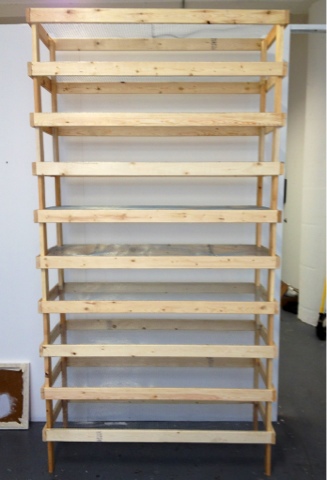
We built custom racks to transport and cure our shallots. The curing can take 3 to 4 weeks, with humidity the greatest factor. Cool, dry, air flow -that's always best.

After 5 days, they'll look like this. 


The Thin Green Bean


Very excited that each and every one of my 5 cultivars of French filet beans are up and doing well. This seeding is a grand experiment in growing what is known as a difficult bean and succession planting -I'm timing the seed plantings to the day. Next planting -June 23.


Nice Rack


And they stack. Over the last day Betsy and I worked on a design for both transporting and curing our 1200 French grey shallots. I finished assembly today. The beauty of this design is that they can be stacked, taking up little floor space and can also fit in the van at harvest. The pine boards are 1x3s and the mesh 1/2-inch. Materials cost - $34.

I'm teaching a drawing class at Sarah Lawrence College up in Bronxville over the next couple of days. After my last class, I will head up the Taconic speedtrap to settle in to a night of couch sleep. The next morning I wake to harvest, load up these very racks, and return to Brooklyn before the elevator operator heads home for the weekend. I do not want to carry 10 racks of shallots up four flights of stairs. Who would? There the shallots shall rest for a month's time, curing, building its tough outer skin. You need that in NYC.


When In Romaine


This is my first time growing lettuce, at least since that long ago slug-infested lettuce patch that never made it in Oregon, 1995. We grew two varieties -a bib type and a romaine; seeds from Territorial. At first I was not impressed with the flavor of the romaine. Now I know why -I was harvesting too soon. Worried about bolting and hot June temps, we began harvesting head after head. But these big beauties, one tear of the leaf told me that they need a little heat, they need to mature in the field. 


Grilled Turkey


Once you've had it, there's no other way. 

I buy the boneless turkey thighs from Di Paola at Greenmarket -they're at many of the locations. A piece this big runs about 15 bucks and feeds four. Depending on the type of grilling arrangement, I'll either put lots of herbs inside and tie the two pieces up with butcher's twine to slow cook or simply rub the herbs all over the pieces and grill straight. Olive oil and garlic, salt and pepper. Always moist and tender. You'll love turkey when you don't have to eat it.


Honey Garlic


This humble, dirty head of garlic is amazing. It's an Asiatic varietal called 'Japanese,' with at most 5 cloves per head and creamy yellow flesh. I harvested nine plants yesterday at the beach farm, nine plants which were given to me for free because other cultivars I purchased were quite small. These too were small, but I'm so glad that they sent them. Ahead of my satisfaction, I ordered a good quantity (although sale quantities are limited by most farmers) for next year's crop. It will take a few years to get these up to good numbers.

One head detached from its stem at harvest and was grilled. The cloves will begin to bubble through the skin -that's when you know they are ready. Grilled garlic has the consistency of a baked potato, but the flavor and sweetness are completely different. And this garlic, this garlic, tasted, to my palette and those I shared with, like clover honey! A distinct floral note above the starchy sweetness. I was blown away.

I highly doubt that this cultivar would produce the same after curing and I suspect it would be robustly garlic-flavored. But green, fresh from the ground, unbelievably like honey.


The Split


It took nearly a month to go from this to that. The good news is I'm nearly there. The other good news is that I am not sharing with a stranger, but with a peer from my Skowhegan days. 

Matt deals to some degree in landscape too, but in a much more analytical fashion. So he should be an interesting companion in the studio. I'm happy that I can finally see my paintings again now that the clutter has been organized. I'm continuing the Prospect Park paintings I've been working on since last year, but also thinking of working with the figure in the landscape more and starting with artists and friends. It feels really good to have my studio back in some kind of order, useful once again, and closer to affordable than two months ago.


Full Tilt


Yesterday was probably the first day I felt less in control of my little, upstate garlic farm. Postponed from Monday to Tuesday thanks to the never-ending rain, we (yes, Betsy came along for the first time) arrived at our plot full of weeds. I had been there only 18 days prior, with 3 solid hours of weeding behind me, and yet the weeds were lush, large, and looming. But there was something else, the shallots, French Grey, had gone prostrate, completely, as if a wall of water had plowed through. I wasn't expecting this, and as far as I knew, there was another month to go before harvest.

Prostrate French

Plantains, grass and clovers

But this has been no ordinary season, and so I put the idea that something was wrong out of my head. Shallots will fall over when they are near ready. They should begin to yellow or brown, but this May's copious moisture has kept them in the green. It is confusing to witness, it looks like damage, but all said, appears a combination of warmer than average winter and spring temperatures and several inches of May rain. Now, please, please, less rain, so that these shallots can dry down some in there beds before I remove them. It's so early that I have yet to prepare a location to cure them, and will be unlikely to do so. Have you seen the seat of my pants flying by?


Rows demand weeding more than any other planting methodology

Fortunately I had Betsy along with me. Betsy the weeding magnate, born closer to the earth than lumbering fools like myself, 90 degrees bent, back aching and angry at such angles. While Betsy weeded, I weeded as well, but then took stock of the state of our garlic, disposed of the weak, inspected damage that appeared to be caused by the nibbling of roots, counted scapes, but cut none, consulted with the property owners about their barn, none too soon to be remanded to the earth. Will it come down in time?


Growing things at a distance is a game of sorts, a gambling man picking his dates like another picks horses or numbers. This date, yes, that's the lucky one; my bet an investment in gas, tolls, and time. Part educated guess, part luck, it is a game I like to play, but sore to lose; I want to be right, and for the crop to be a success, I need to be right, or close to it.


But then there are moments, say, when I see that the blue in the Italian Purple rocambole is quite similar to the blue of the spruce across the way, or the pleasure in a well-weeded row, or the marvel of quantity.


We strung up the shallots, fooled into thinking it wasn't near harvest time. It is.

 And left scapes alone, fully aware I would need to be back soon.

Late, I disrobed for full tick check. Lucky I did; inside the shirt, approaching the scruff of my neck. I think it found me at the edge of the woods. Betsy was all clear.

We sped off, later than usual, marveling at the Hudson River scenes as I kept a wary eye for suicidal deer and the law. My next visit will be soon, a week's time, 7's a lucky number.


Socked


With rain. Now I'm glad I pulled the turban and asiatic garlic from the beach farm. I called off my upstate farm trip today, not sure that the timing is critical. Maybe tomorrow, maybe Friday, but sometime soon. From warm and dry to cool and wet. Fickle jet stream.

First Fifty


It was a hot, high dew point day, the kind you happily fight traffic to make way to the ocean, the kind we've been having lately. The wind was strong off the ocean, and welcome.

I did have purpose, other than cooling off, and that was to harvest the Turban and Asiatic variety garlic. They had mostly scaped, and were browning leaves at a rate that made me nervous given the imminent threat of rain. We've had quite enough rain over the last several weeks, and good garlic prefers a week or so of dry down before harvest. It had only two days, and that was going to be enough.

I won't give the reason, although I suspect it had something to do with the decayed outer wrapper, that had almost every root bundle the home of an earthworm or two. Can you see him, dead center.

It is normal for the outer wrapper to decay in the final month of growth. The wrappers of garlic are all leaves. As the leaves dry down above ground, they decay around the bulb, underground. We do not want the garlic in longer than necessary because of the potential to lose more wrappers as more leaves dry down. The wrappers offer protection to the bulb in storage. If the splitting you see above became more severe, perhaps in several wrapper layers, it would invite moisture, soil, and disease. So the early bulbs need to be pulled when they need to be pulled, especially if rain is forecast. We heart our wrappers.

Incidentally, we had these mushrooms sprouting, all over, just underneath the soil line. At first we thought, we hoped, that they were puffballs, but I've come to the conclusion that they are immature stinkhorns, which seem to really like our wood chip paths.

A posed picture. The whole affair at the beach farm is a practice run and coal mine canary for our upstate garlic harvest. We should be about two weeks ahead at the beach farm, and now I know to ramp up my attention, as I've only been visiting the upstate farm once a month until now.

Well, the storm materialized to the northwest, and although threatening, never actually wrung any serious moisture on the beach farm.

As the clouds built, I did a cursory cleanse of the lettuce. Lettuce needs washing, and washing again. A snail and a worm or two figured out I was growing the stuff. The snails prefer the bib, the green and black 'pillars the romaine. Me -I'd rather eat snails with my lettuce. Watch out snails.

The first fifty. No, it has little odor once it begins dry down, but the soil drops and scatters. I'm still looking for a cure site for the next 1950 bulbs. I've got lots of ideas, some prime, some less so. The living room? Less than prime, but air conditioned which the bulbs take to quite well. There's a barn where I'm growing upstate, but right now that barn is up in the air -although I got wind that maybe the masons are coming to pour a foundation on my next visit. Well, I don't think I could ask. I need to find a local spot and I think it's entirely possible, with some fans, and a dehumidifier, and some luck.


The Cure


These curing Allium vineale inexplicably have the odor of the most intriguing garlic salt. Yes, garlic, but the clinging soil is possibly adding something else. When young and green, the field garlic has a more earthy onion/garlic scent. It is now intensifying into something quite a bit more beguiling.