"...there must be no talk of moods in things they must need accomplish. They must be free from this care and that they must not let their feet linger. It does not turn to summer after spring has closed, nor does the fall come when the summer ends. The spring ahead of time puts on a summer air, already in the summer the fall is abroad, and soon the fall grows cold. In the tenth month comes a brief space of spring weather. Grass grows green, plum blossoms bud. So with the falling of leaves from the trees. It is not that the trees bud, once the leaves have fallen, but that because they are budding from beneath, the leaves, unable to withstand the strain, therefore must fall. An onward-urging influence is at work within, so that stage presses on stage with exceeding haste."
Yoshida Kenko, 14th century
_______________________
I've always loved photography, since my first 110 camera. I remember my first picture - a seagull passing in front of the summer's evening sun, to the west northwest of Hither Hills State Park not far from the town of Montauk, on Long Island. I think I was 6, but maybe I was 10, so at least somewhere between those ages. My incredibly crisp recollection of that moment is probably the memory of its photographic image, intensified by an aggregate of sensory experience of summers near the ocean. Film was a precious canister of patience, you waited, you were discerning.
My early experiences with paint were often with the putrefying, outdated tempera paints available at school. Their colors were pale with adulterants and the finished project flaked off the paper with any wrinkle. When my sister received a paint by numbers kit, she was probably eight or nine and I just a year or so younger, I stole into her room to check it out. My memory of this experience is visceral, both tactile and olfactory. I wasn't much interested in the picture, a horse in a gradation of browns. No, my focus was on the half inch semi-translucent plastic rounds strung together and lidded. In each one a rich brown in various shades sunken under an eighth-inch amber fluid. I opened each canister, dipping my pointer finger into the fluid, then raising it to my nose. This was my first experience of oil paint and I still, on occasion, lift the tubes to my nose.
______________________
As a young man I was feverishly involved with abstraction, with the composition of my gestures, with layering of translucent color, and light and dark coming from within the painting. Later, I began seeking new challenges and ways to undermine the repetitiveness I found in my work. I began looking less toward abstraction and more at the world around me. That was over twenty years ago.
I went to graduate school in southern New Mexico to work on the observational drawing skills that seemed to elude me in those earlier years. What I learned there was that I am a keen observer, not at all impatient, drawing was not the problem, and the intimate experience of land and space had become my subject.

____________________
In the summer of 2000 I attended Skowhegan. The peculiar experience I had was that other artists seemed to be more interested in the performance of landscape painting than the resulting works. I always had a bit of anxiety about being an artist on the land, so I instigated a project as a way to confront that anxiety.
In Janine Antoni's presentation to the artists I became aware of a work that she had begun on campus, in the upper field, a few years prior. What I saw was an effort of labor and a relationship between the artist, her work, and the land.
At the same time I was reading Thoreau's
The Maine Woods, in which he described the woods filling in to obscure his path as he cut it. I decided to explore the field in search of the remains of the circle she cut through the field in the making of her work, and trace her path to resurrect it from the oblivion of natural growth. What I found were remnants of trenches designed to support timbers arranged to hold the stones. With that, and the photo from her catalog in the library, I was able to piece together the location and diameter of the circle.
I staked the ground and began to walk. The plan was to walk every day for two hours, at different times as schedule permitted, rain or shine, until the circle was complete.
It took three weeks. In so doing, I became a body present on the land, an ascetic as much as an aesthetic laborer.
___________________
I returned to New York City after Skowhegan and had difficulty building interest in my painting. In fact, I began to feel my painting was going nowhere, within the studio and without. Was it the loss of the desert subject, being in the city, or was it the practice altogether? After 2001, most paintings I began on site went unfinished. I toyed with painting from projections of my slides, but I found the process tedious and disconnected. It wasn't until 2004 that I began painting seriously again.
Yet I continued to make landscape projects. In September of 2001 I was at Socrates Sculpture Park to erect a greenhouse, complete with brick floor, electricity, and plants. I had built a private landscape within a public park, again my presence on the land being part of the work. I couldn't be present everyday, but I became a sort of public hermit at night and on weekends, in my little "house."
The only activity I defined for my residency period of September 2001 through June of 2002 was to keep the plants alive and healthy through regular visits.
The small greenhouse is a desirable object, an attractive marker in the landscape. It speaks of leisure, not work. Visitors interacted with it in their own ways, but were locked out from all but viewing the interior through the crenelated panels. Sometimes I arrived to find it had been broken into, cigarette butts laid on the table. Others shrieked when they realized somebody, a body, was present inside as they peered in through the panels. Small children climbed in through the vents and retreated in fear when they became aware of my presence.
Often I had the park completely to myself, which was a great pleasure in a city wracked by September eleven. The miniature landscape became a sheltering escape, a coping mechanism.
________________
I met artist Carrie Mae Weems at Skowhegan in the summer of 2000. She had been a supportive yet tough critic that summer. I worked for her for a period, and saw her from time to time afterward. In 2005 she encouraged me in subtle and quite direct ways to consider photography. She wondered aloud what a painter might do with a camera, but ultimately suggested it in the service of painting.

Although I resisted this for years, that fall I began using my digital photographs as source material for paintings and drawings. The process engaged me, quite unexpectedly, with several new challenges. I appreciate the intensity of feeling people have for an on site painting experience; it's not unlike painting the figure -it is immediate, you must adapt to changes, engage your senses, and the paintings have a freshness that only stales in relationship to its conventions. However, what impresses me after many years of working with the photo is that each day I return to the studio I see the static image quite differently. The photo-source allows me an experience of observation and painting, of digging deeply into an image, and painting without the constraints of time.
______________________
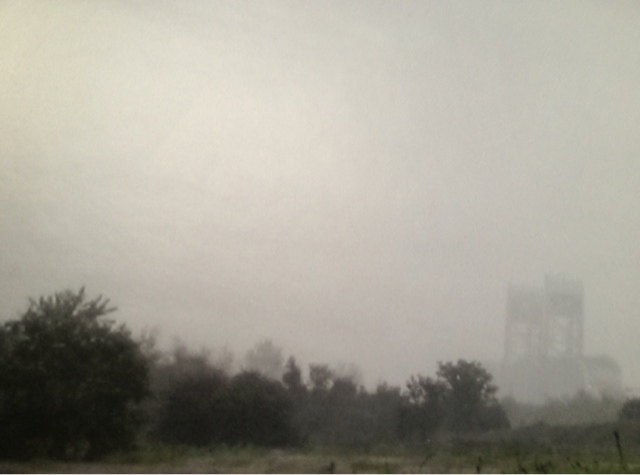
I have a photo of a bridge to the Rockaways on my wall. It's been there for some time, and was intended to become a painting, but that painting was never made. The original image was a small file, taken on my first digital camera. To print it large, I needed to upsample it in Photoshop. Unlike many small photos printed this large, the artifacts of the upsample process did not wholly undermine its printed quality. In some ways, it makes the photo, and I like the photo as it is, and this makes it suspect as a source for painting. A good photo doesn't need a painting; a good photo is not a painting problem.
________________________
In a little while I will be leaving for a new landscape -the hardwood forests of nearby Connecticut. I will be the artist in residence at
Weir Farm Art Center, part of the
Weir Farm National Historic Site. Last January I spent two weeks in the winter wonderland of New Hampshire at
MacDowell Colony. This new program will be much different -I'll be the only one in residence, with all the house-keeping, cooking, and what-else performed by yours truly and that's just fine by me. If they'll let me, I may even get to cooking over fire.
I know little about the woods of Connecticut, only a slight sense of it from drives on the Merritt Parkway. I'm hoping for Beech trees. I like them most in winter when they appear like apparitions in the woods, but I'll take them in late spring without complaint. There are hiking trails throughout the acres that I will have to myself, I think.
The site is surrounded by woods and residential development; not too far from NYC. The landscape was a farm and artistic retreat for painter J.A. Weir in the late 19th century, then artists Mahonri Young and Dorothy Weir, and lastly, before it became a park, artist Sperry Andrews. It is the rare home and studio that has for over one hundred years been in the hands of artists.
I'm interested in the role of the rural retreat as a nurturer and shaper of art. Most artist residency programs are in locations removed from urban settings. Obviously, it's the quiet, the lack of social distraction, the clean air- it can clear your head. But as a landscape painter, I'm more interested in the institution of the bucolic, art retreat and how it shapes a way of looking at landscape and art. The easel painter 'en plein air' is certainly a part of this set of expectations.
Do you remember when Captain Picard would retire to his quarters on the Space Ship Enterprise to paint at his easel? This always made me cringe. How is it that easel painting is still the image of art making? I find it hard to imagine people in space, traveling the light years, painting at easels. Is it the lack of imagination on the part of film and tv that brings us this image?
______________________________
The radar has been showing no rain for hours, but for hours I've looked out the window and saw mist, sprinkles, and rain. I went out for a walk, to make some more movies, and just to get out.
In NYC, one rarely has the feeling they can slow down, move slowly through a space or landscape. As I move through the grassy fields at Weir Farm, I have a heightened awareness of what appears as intentionality in its formal boundaries. It's in the light transitioning to the dark, abruptly sometimes, other times gradual. It may only be incidental to field and stone wall architecture, where trees grow and create dark spaces that are then punctuated by bright, grassy fields beyond, then again broken by the deeper woods.

_______________________
I recently finished Ordeal by Hunger by George Stewart, the harrowing tale of the fate of the Donner Party. I spoke about it with National Park Service ranger Emily and another woman from San Francisco. Each of us had read the book at some stage in our lives. The woman (excuse me as I do not remember her name, lets call her Ruth), Ruth, was in her late sixties and she said the story was all the rage when she was a kid. Emily, the park ranger, is in her mid-twenties and she read it in high school. Having just finished the book myself, I began asking around, "have you heard of the Donner Party?" Every person I asked said in return, "Jeffery Dahmer?" How odd. Ruth says she thinks it's odd that there is a diner at Donner Pass and yet every year her family would eat there on their way to Idaho.
It doesn't escape Ruth or I that Interstate 80 occupies much of the same route as the Donner Party trail. It cuts through the Wasatch Mountains, the very same path these California-bound pilgrims cut with brute force and determination.
Ranger Emily tells us that the artist Mahonri Young, a Mormon, had included a depiction of the Donner Party in his most famous work, the monument This Is The Place, in Salt Lake City. Young lived at Weir Farm after he married Dorothy Weir, daughter of artist Julian Alden Weir -the namesake of the National Historic Site. Mahonri Young was the grandson of Brigham Young, the man who lead the Mormon pioneers to Salt Lake via the exact same path that, less than one year earlier, the Donner Party struck out on. What did he know of those who cut their path? Did word of the tragedy confirm the divine wisdom of Brigham Young to the Mormon pilgrims? Did it convince him of its rightness?
It was during these same years that Henry David Thoreau was having his nature experience on the opposite coast, an experience of self-proclaimed self-sufficiency while under the spell of the morning star. What if Thoreau had left the cultivated east, and struck out west for his year of nature experience and writing? What if, by some accident of fate he had found himself accompanying those who journeyed to discover their holy place, or those destined to consume themselves on their journey to economic salvation? What, then, would Walden have reflected?
___________________________
As much as you do, undoubtedly, I grow tired of the tense shouldered, hunching posture of winter, the gray ice pavement, even the frozen dog turds. But I don't want it to end. I cannot ask for it to be over. Time is as slick as that puddle ice. GO SLOW. The quiet is everything. Spring moves far too fast for me to beg for it. It is something to be savored, contemplated, in the ever-lasting distance of winter.
I've been relishing the brilliant spring greens and pale reds, some of the best I can recall, at highway speeds for a couple of weeks now. First on my trip to the upstate garlic farm, and this week on my trip out to Amagansett to explore a possible location for next year's crop.
I cannot recall winding my way through the Long Island Pine Barrens in early spring, since my trips to the farthest reaches of the southern prong had always been reserved for summer days.
The colors this year rival autumn's best. The russet and salmon reds are the most intense I've seen, contrasting as they do with the long-holding chartreuse.
Add to this the dark greens of pitch pine, and...

the white-green of blooming, roadside russian olives, and...
salmon-pink sheep sorrel and the ochre of old grasses...
and you have something I could hardly take photographs of, with my phone, while speeding down the highway at 65 mph. It all made me wish, much like two weeks prior, that I didn't have purpose other than finding and photography.
_________________________
I was in the studio the other day, working on some unfinished paintings. On the radio was Fresh Air. Terry Gross was interviewing Jonathan Franzen. I had read his book
The Corrections and, after the interview, am considering his new book
Freedom. I was interested in something he had to say on adulthood:
"And the key moment of becoming an adult, the difference, one of the defining differences between an adult and a kid is that adults relinquish a certain kind of freedom. You can't lie around on your bed all afternoon, and you can't be possibly any number of things. You have to only be one thing, or a couple of things (my italics)."
I am haunted by this. The notion of being "one thing" has been going on a tear in my mind the last few years, growing in strength as I approached 40. What is it that keeps me from painting every free moment? How much time should my other landscape activities be taking? Should I be making a living on the land? It's like I have been living a life visible through a kaleidoscope, looking in there are all these pieces of me spinning around, somehow not whole or resolved, yet you know there is a whole person there.
When I was in residence at Weir Farm, last year, I spent much more time exploring the land than painting. I read books, I photographed, I blogged. Why paint when I can communicate in such a rapid manner?

Yet, I've been working on a small group of Prospect Park images. Most include people. The colors are insanely green, toxic green. My colors are not to everyone's taste, but then
what is?

Neither of these is near done, although this one is a little further along. Space, atmosphere, an intimate relationship with
distance is important in this work.
______________________
In the autumn of 2001 I had an experience at the Mattituck Museum, in Waterbury, Connecticut. The exhibit, Images of Contentment: John Frederick Kensett and the Connecticut Shore was on display upstairs. His Hudson River School style is typically described as Luminism, its hallmark a tranquil scene with evanescent light, and in Kensett’s case -more often than not an image of the conjunction of water and land. The impact of each work is an experience of restfulness and calm, a bath of even, transcendental light in the reassuring, supportive bosom of nature.
On the first floor was Mattituck's permanent exhibit titled Brass City –a brutal display of miserable working and living conditions in Waterbury, one of Connecticut’s several industrialized river cities through the 19th and early 20th century.
In this contradiction I recognize how the Hudson River School paintings were a looking or turning away.
The history of the Hudson Valley is one of industrial and commercial enterprise, of resource extraction, where the hills, especially those closest to the river, were cleared of timber for use in iron production, charcoal production, tanning, building, and of course, cleared for farming. The valley was home to quarrying for road making, building, brick making, and of course, cement production. Rail and steam terminals, dikes and dredging, and other riverside alterations were commonplace thanks to the opening of the Eerie Canal in 1825. One hundred or so brilliant white ice houses, many hundreds of feet long, were built along the river to store ice cut from the frozen river to ship to NYC. Yet it is the rarest of paintings from the time period that represents any of this. The image below was made by one of the "lesser" artists of the time -it depicts industry on the shores of the city of Hudson, NY.
I expect people to desire the dream, but what never occurred to me is that anyone would confuse Hudson River School pictorialization for truth. The painters of the time, like any artist, did not stay true to the world before them. No, they were creating visages of a dream and they were as well aware of it as we are today.
A view shed has been defined as:
"the geographical area that is visible from a location. It includes all surrounding points that are in line-of-sight with that location and excludes points that are beyond the horizon or obstructed by terrain and other features."
This singular point of view sounds awfully like perspective, a system that prioritizes the view of a single eye, a single individual, or in the case outlined below, a single institution. This singular point of view is an expression of the utmost power, not the benign locus of landscape appreciation.
I've always found the term view shed indigestible, primarily because it shifts meaning from laws of fluids and gravity to laws of man. So how does eyesight flow, how is it "shed?" That single viewpoint radiates outward from a point somewhere on a 35 mm retinal disc. The shedding is done by the human brain, and what flows from it is not out there, a part of nature, but something within the mind of the shedder. Optics prevent us from seeing around obstructions creating what amounts to blind spots, but what of the "view shed" in the age of technological prosthetics like drones or remote cameras?
Nowhere has the application of this idea been more apparent than in the Hudson Valley, where the view shed has been legitimated by the apparent "truth" of Hudson River School paintings. While there are many grand views in the Hudson Valley, the most often cited, preeminent view is that from Olana, the home and landscaped acres of the Hudson River School's Frederic Church. While there is plenty of evidence, if one aims to find it, of quite a different landscape in his day, it appears that plaintiffs commonly utilize the "historic" view as the basis for legal argument against any industrial activity that may alter it.
“This discussion, while it addresses the prospect of a nuclear power plant, is not about nuclear energy,” commented Sara Griffen, President of The Olana Partnership. “It is the story of how the importance of the Olana Viewshed factored into the siting of a plant, and how this mattered on a national and regional level.” “Olana is famous for its breath-taking panoramic views that draw thousands of visitors to this magnificent historic site every year,” said Kimberly Flook, Site Manager of Olana Historic Site. “It was Frederic Church’s vision that actively shaped his landscape to frame the Hudson Valley’s unique natural beauty."
"The resulting Environmental Impact Statement caused the Nuclear Regulatory Commission staff to recommended denial of a construction license for the proposed nuclear power plant (just south of Catskill). This was the first and only time that such a recommendation had been made on any grounds—let alone environmental or aesthetic."
The image below is an "artist" rendering of the view of the proposed power plant, looking south from Olana. The rendering isn't terribly offensive, except that the image of a parabolic cooling tower has become an architecture of anxiety.
Again and again the "historic view" is used as justification to halt or alter proposed industrial projects in the Hudson River Valley. One of the more recent and controversial was the case of the proposed St. Lawrence Cement plant in the town of Greenport, NY, just upriver from the now hip town of Hudson. The National Trust for Historic Preservation cited the St. Lawrence Cement Plant as an imminent threat to the area, declaring the Hudson River Valley one of America’s eleven most endangered historic places, as its scenic areas and historic landmarks are constantly threatened by sprawl and industrialization.
Mark Brobowski's study, "
Scenic Landscape Protection Under the Police Power," shows us
that the Supreme Court decision in 1954, Berman v. Parker, 348 U.S. 26, helped pave the way for future landscape preservation efforts based primarily on aesthetic values." Further, he states "The increasing value of tourism to local economies has prompted local governments, under their police powers, to move towards legitimizing aesthetic regulation, and landscape protection based on aesthetic values has evolved from a secondary purpose to a constant theme in environmental protection (Brobowski 1995, 700-702).
The view shed is not so much something to protect as it is an
enclosure of a kind, a way to exact a great, limiting influence over many square miles of land and the human activity within it. At who's expense is the view kept a dream? We all dream of a land unspoiled by industry, but we have to engage it to deal with it. A quote from the brilliant Paul Shepard:
"My point is that their origin is inextricably associated with a surplus agriculture, that cities tend to grow beyond what the local agriculture will support, and that there is an urban attitude toward nature which is insular, cultivated, ignorant, dilettante, and sophisticated. At the same time, by virtue of the very polarity in the landscape that cities create, they contain and educate and produce men who retreat to nature, who seek its solitude and solace, who study it scientifically, and who are sensitive to its beauty. The very idea of a sense of place is an abstraction, a sort of intellectual creation like sex or climate or fashion, which is impossible except in a world of ideas whose survival depends on the city. The dilemma is that those who yearn for the warm garment of landscape security are already deflowered. They can only go back so far. They can regain the hunter's, pastoralist's, farmer's nonverbal responses, limited to an extent by their self-consciousness; but the yearning is thrust upon them in any case, for they were all children once and they had wild ancestors and they dream and to some degree all have premonitions of special places."
My initial impulse to paint the park grew out of my excitement for the spring color of trees. Over time the work was carried on out of the feeling that it was as much my landscape as ours. I began to believe in the public commons, not as a preserve or even a special place, but an ordinary place that defines our relationship to nature. Painting landscape is a reflexive act, a looking back, but how do I do it so it is not also a looking away, a premonition of pastoral dreams? In painting Prospect Park, I've chosen to intensify this reflexivity as a way to move my work forward.


______________________________
Below is a discussion, a critique, of The Highline and Brooklyn Bridge Park. Both are new parks developed during the Bloomberg era and, I think capture the attitude of life in NYC. While I think many of my thoughts are still relevant, I developed these essays before either park was open for viewing. I love the physical Highline, its planting and architecture, the way it floats above the traffic below, but do not connect with it as a parade ground and viewing platform. I have mixed feelings about Brooklyn Bridge Park and admit that I have spent little time there since it has opened.
___________________________
The Problem With Brooklyn Bridge Park
The proposed
Brooklyn Bridge Park contains 85 acres, including 6 piers and 1.3 miles of waterfront. The estimate for the budget to build Brooklyn Bridge Park is $370 million dollars. This is massive public spending for a park that is, from what I've seen so far, a much
less ambitious design than Central or Prospect Park and without any of the democratic rhetoric of either of those projects. Assuming that the land was still available, as it is for BBP, it would be possible to build both Central
and Prospect Park for less money ($312 million). Somehow, Parks and Recreation Commissioner Adrian Benape sees this park as "
a bargain."
What we get is a park that operates primarily as a
plinth for the viewing of lower Manhattan, an interface for harbor activities, athletics, concessions, and a deepening real estate boom where it isn't at all needed. Should this area be a park? Of course. Are we getting our public money's worth? Not at all.
The north end of Brooklyn Bridge Park, years ago re-configured into a public park where it was once a run-down, old New York kind of hangout. There was a time when hardly anyone would accept a park in this location, if only because of the incredible amount of rattle and thrum from the trains on the Manhattan Bridge. Not anymore, ever since artists and musicians gave the Walentas family the Dumbo it always wanted and the massive gentrification of Brooklyn's gold coast, there has been pressure to transfer dilapidated, once working waterfronts into leisure grounds.

As smaller city parks go, the old Fulton Ferry Park is popular -people are sprawled out on the grass in warm weather, wedding photos are taken, tourists photograph the bridges, dogs are walked, little kids are bicycle-trained. The crowds accept the noisy racket of the bridge and embrace the waterfront. The concept here is a bold revision of the city's infrastructure as a sublime backdrop for leisure and a long overdue acceptance of our desire to be near the water. The pleasure here comes from the calming of the watery middle ground while the Manhattan Bridge's massive, dark underbelly and rumbling incite.

The Brooklyn Bridge operates on the level of a functioning ruin in the landscape incorporating a sense of history into the picturesque sublime. There are hints of current day ecological influences in the native plantings. The massive stone ampitheater and kayak-launching beachfront under the Manhattan Bridge are two bold strokes. This experience is as a big brother to those significant, original design decisions at Gantry Plaza State Park in Queens.
Touted for the new addition to Brooklyn Bridge Park is the view of the palisade formations of lower Manhattan. Yet, much of what I get from the view of the lower Manhattan skyline I already receive from the
Brooklyn Heights Promenade, along with its quaint nostalgia for old New York. The low viewpoint offered from the piers has the effect of bringing us to the foot of the Emerald City, looking up, and if you're me - get to thinking about who's behind the curtain.
The sketch below, from the
Urban Strategies Inc. website, proposes something of interest. It appears to add something new to the context between the bridges that I can only hope survives the process.
A park with such an exhorbitant budget should have a bold design. Not only formally, but conceptually. A park that incorporates new conceptions of our relationship to nature. A park that gives us more than the plinth effect. Telling is that this new park is named after the Brooklyn Bridge. After all, that's the part of the park that we know has a heart. That's also the part that is essentially finished, functioning as it should, and won't require residential development to "pay for its maintenance."
________________________
What Should Become of Community Gardens
...Community gardens should be made into NYC Parks. This is the only permanent solution to city-owned lots that have the potential to be sold for housing. Although history has shown us a few fools to suggest it, land under the Parks sign should never be looked at for development. As NYC parks, community gardens combine Olmsted's democratic rhetoric with community gardens' democratic aesthetics. As I question the passive use of our parks and wonder what more active involvement in parks would look like, I've come to the conclusion that part of the answer is in community gardens. Could the community garden be the seed of some larger civic park landscape?
_________________________
High Time For the High Line

There has been only one major park in all of New York City that has managed to go from waste land to park land in 10 years -the
High Line. Recent
money donated has given the completion of the new parkway a boost. In fact, as the New York Times
pointed out, "This could be the friendliest public/private venture ever attempted in New York City." With a total cost of about $150 million, the High Line has created a stir at under half the cost of the proposed
Brooklyn Bridge Park. Of course, no one can complain about the private capital connected to the High Line, as that it is of
its essence. While the city owns most of the High Line trestle and NYC Parks
appears to have
some role to play, it is not a stretch to view this parkway as a privately funded and maintained park that offers access to the public.
As a public/private partnership, it makes sense that this parkway has a dual personality -its public and private function. It is the most viscerally dual-purpose, built landscape that I can think of. On the one hand it is a high fashion, high design parading platform for the the viewing of NYC architecture. On the other, it is a lowly, industrial structure, re-visioned as a metaphor for a car-less NYC. One aspect serves the vanity of individuals, private institutions and developers' dreams, the other has the potential to serve the public imagination of a future NYC.
The High Line is an elevated parkway connecting destinations and residential neighborhoods. In this way it is not unlike Vaux and Olmsted's
original NYC parkways designed to separate horse carriage, and pedestrian travel. Yet the new High Line parkway will function as a platform for taking in the sights of lower and midtown Manhattan. Imagine it as a stroll through a sculpture garden, but the sculptures are the size of buildings. If you live or work in one of these
new buildings, you can take the step back to appreciate how wonderfully your own
starchitect designed building resides in this newly structured New York landscape. If you do not, you may stroll the High Line, panoramic foldout at the ready to identify any building seen in the growing architectural landscape. This is the essence of the private High Line.
On another level we have the romanticization of the railway ruin. Functioning and defunct railways have been picturesque components of landscapes for decades, and their minimum of infrastructure is easily incorporated into park designs. These ruins have hosted many parkways throughout the country, mainly as part of the
rails to trails initiative. In Paris, the
Promenade Plantee created a formal garden from an elevated railway. Many cities are now looking at conversion of their dilapidated high rail. In our own city,
Gantry Plaza State Park incorporated industrial rail into its original park design in the mid 1990s. The incorporation of rail into park design isn't new, growing out of an attempt to make sense of a post-industrial landscape -often the only new space open for park development in our urban centers. What is new, however, is the
attitude of an elevated railway park in NYC.
It is my view that the primary public aspect of the High Line is its manifestation of a changing attitude towards street vehicles and traffic. It does this by
anticipating an elimination of vehicular traffic below, ironically through the preservation of the conduit for a mode of vehicular traffic previously considered
too dangerous to keep at street level. It allows us to walk along the previously unsafe terrain of train track and in doing so, gives us a glimpse of a future where walking along the street is safe. The High Line removes vehicular traffic from our urban experience in what appears an apolitical, non-threatening fashion -high above the streets, out of sight and mind of the political body of vehicles racing below. Lastly, the High Line's elevation promotes a sense of the civic idealism to which it speaks while, to the speedster below, perhaps, it's a floating spectre of a return to biological speed.
As we watch the collapse of the American auto industry, and entertain the idea of a city free of automobiles, what new urban landscapes will we dream up?
________________________
Wet Dreams and Other Pursuits
This is how most folks at the garden (or any garden) like to water their plants. They probably have a trigger spray nozzle or some such device. I cannot explain the feeling given by watering plants this way, but it is definite and possibly trance inducing. Is it the sense of control over one of the most important elements in all of life? Is it the power of 'making it rain?' Or is it something more sensual -the wetness, the mist, its cooling effect? Could be its sound, the splish and splash, but what of the pfffffft? I cannot say.
No matter, I make it rain with electronic valves and gravity, near the ground and at regular intervals. This is smarter because no matter what anyone says about farms in the city, I will not be slave to watering or rain. I am a city dweller and I long to escape for two weeks at a time, to see the land and its produce, to marvel at the broad expanse of forest and field, to bathe in the cool moist understory of air seeping from woods on hillsides without ever worrying of his tomatoes or green beans -that is in the contract! You -in the countryside will have great expanse and distance between you and others, neighborliness and drive by wavings, a slow pace, cleaner air and honesty. We -in the city will be free from rising at dawn to milk the cows, will have variety in all things, hustle, bustle and irony, and never, ever, will we have to worry about the state of the food growing on our little 'farms.' Because I am a city dweller, I must tend to other pursuits.
__________________________
The Eddings Tide
I was as surprised as anyone when I heard of Amy Eddings', host of WNYC radio, departure from New York City. Not because her decision was shocking, or even that she has chosen to leave the number one public radio station in the nation, but because, and I sense I am not alone in this, she is moving to Ohio. Anyone who has heard my road traveling stories knows well enough that I'm not sweet on Ohio (although they do have the best rest stops between New York and Wisconsin) and I thought, good lord, what will she do there? Where is
this Ada? Parents passing, or have already passed? Going home? What?! This morning I decided to discover why and what I found is that there is no one to tell it, but
her.
I met Amy once when her program asked me to come up to the station to
explain the difference between pea shoots and pea sprouts and concoct
a recipe to share with her listeners. A minor connection, really, yet in reading through some of her blog posts I see that her reasons for leaving WNYC and New York City are, at least in general ways, quite like our own. We share (or, maybe I share it with her husband, as we both moved to the home regions of our wives) that sense of insecure longing for some thing or event that validates our decision as the right one. Inescapable to any ambitious person leaving NYC is the thought that they are leaving the game, maybe their ambition has melted away and are putting themselves out to pasture. Yet, what grips my thinking, now, not quite four weeks after leaving, is not what I have lost by leaving NYC, but what I have gained, and how remarkably privileged we are for being able to do so.
NYC can shield our privilege behind crumby buildings, raucous neighbors, dirty streets, and low-paid work that is largely chosen, not inherited. In the context of that great city our income, our utter lack of savings, retirement planning, or insurance made us feel poor, but truly we are rich in the context of the poor. Outside of that city we shed that shielding skin and with considerably less conflict than if we had sold off our far away inheritance to make the best of
someone's misfortune, a crumbling house in the gentrifying edge of a community about to be displaced.
So we are now suddenly landowners, suddenly landowner-
neighbors, taxpayers, insurance payers, and so on with more house and land than we can justify, or feel completely comfortable with, in a region of homogeneous ethnicity and income. Despite any misgivings, we intend to make the most of ourselves and new home, with hope that we can find an income stream that allows us to stay here, in the upper midwest, or what I prefer to call the northern tier, or north woods, or some such descriptor that doesn't exact such dismal recompense, and continue our creative industriousness.
_______________________